

| Main centres: | 1-3 business days |
| Regional areas: | 3-4 business days |
| Remote areas: | 3-5 business days |
This is a deactivated Martini Henry I.C. 1 Cavalry Carbine made in the year of 1879, a year of the Zulu War, by the Royal Small Arms Factory Enfield (RSAF Enfield) . This particular model of rifle would have likely been used in the latter stages of the Zulu war, and saw heavy use during both the first and second Anglo-Boer wars. These rifles in their 577/450. configuration are starting to get rare, as so many of them were later converted to .303.
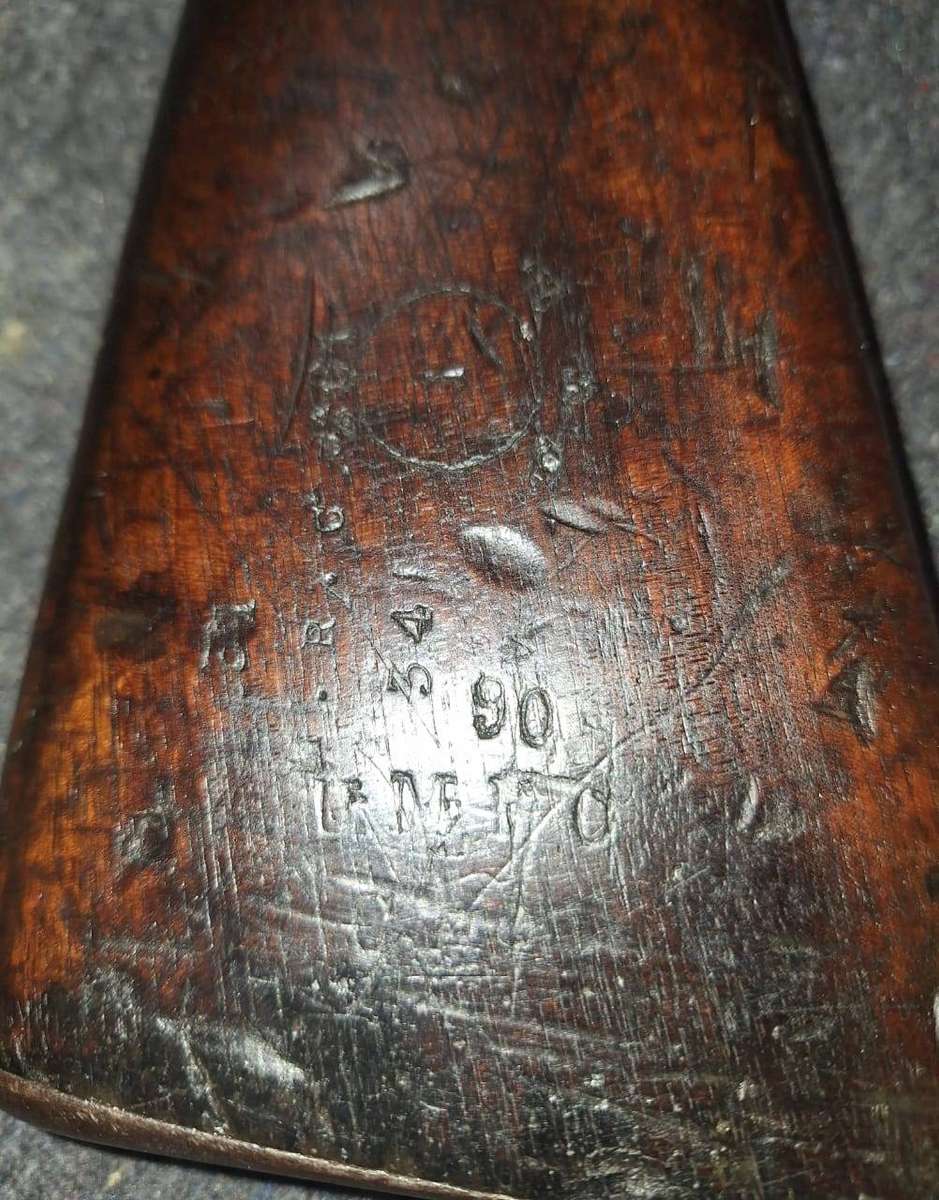
This rifle is stamped with K.T on the knoxform, which stands for Kingwilliams Town Arsenal, a town in the former Cape Colony. Further, the top of the reciever, where the barrel meets the receiver, is stamped with a Crown above a 3. This is an early Cape Government mark which predates the more common C/|\G stamp. In addition to this, a unit mark is stamped into the stock next to the roundel, and at the bottom of the stock, a faint C/|\G and Sold out of Service arrow-to-arrow (-><-) can be seen.
The screw holes beneath the sight have not been plugged, a modification which is often seen on cavalry carbines of the period, including Lee Metford/Enfield carbines. These screws would have originally been used to fasten a sight protecting hood which would also aid in the smooth drawing and placing of the rifle from and into its cavalry bucket. Thus, these screws can be replaced, and a new leather sight protecting hood installed.
Overall, the rifle's stock shows evidence of consistent use, with nicks and dings being concentrated in particular areas, indicating that this rifle has spent considerable time bumping into something hard, like a rivet in a leather rifle bucket. The stock had been recently oiled with a number of applitcations of Boiled Linseed Oil, as would have been done originally. There is slight play to where the fore-stock meets the receiver where the wood has shrunk due to age.
All the components of the rifle are present and intact, inlcuding the rear sight, which has its slider free to move, as it should be. The metal components have faint pitting all over, but most of the original blueing remains, presenting an attractive patina.
The rifle is fully deactivated, with welding applied to both the breach block and lever.