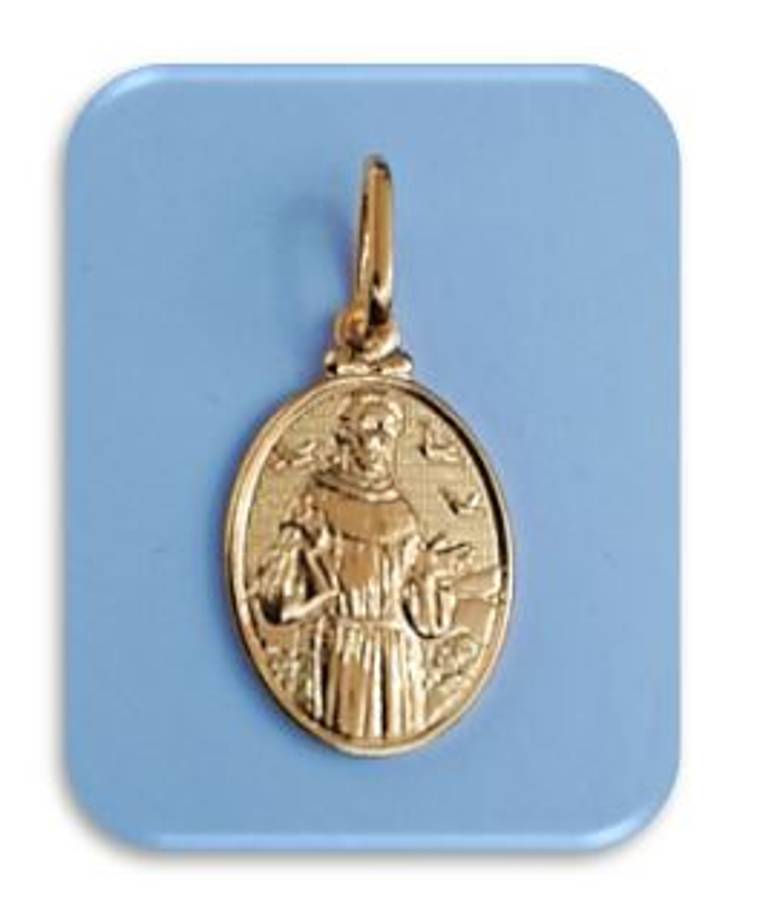
18mm St Francis - 18kt gold filled Pendant
18mm length x 12mm wide - 1.17grams
Does not include the chain - presented in an organza bag
GOLD FILLED
Gold-filled, or "rolled gold", is created by bonding or "welding" a
thin layer of gold to a base metal core. This is achieved by using heat
and pressure. USA industry standards require there to be 1/20th by weight layer of 14 karat gold permanently bonded over a core of base metal.
When you come across the reference "18/20 Gold-Filled" this means that item is 1/20 18K gold or more simply put the 18 = karats and the 20 refers to the % of gold in an item. 1/20 = 5% gold. The 1/20 fraction refers to the ratio of the 18 karat gold layer to the base metal (brass) layer by weight, which is 5% The base metal is most likely to be brass. 18k Gold Fill (14K GF) has ± 100x more gold than a gold plated item. The gold layer found on 18K GF items is usually 50-100x thicker than what is found on a gold plated item.
Gold Filled is hard wearing and if looked after like fine jewellery it should last a lifetime.
Suggested Cleaning Methods
Use soapy water to clean gold filled - Mild soapy water and a toothbrush a child's soft toothbrush and a mild detergent is the perfect combination for cleaning golf-filled jewellery. The detergent can remove residue or fingerprints from the item, and still leave it shiny and bright when it's done. Be sure the toothbrush is soft or it may scratch your piece!
Brilliant jewellery polishing cloths are safe for gold-filled soft cloth using a clean, soft cotton cloth is an ideal way to polish your gold-filled pieces. A soft cloth will not scratch the surface. There are treated jewellery polishing cloths, such as Brilliant, that work well; however, some chemicals are not recommended on gold-filled items so double check that they are safe to use. Do not leave chemicals on your gold-filled. Always rinse and polish again with a soft cloth to remove residue.
Saint Francis of Assisi abandoned a life of luxury for a life devoted to Christianity after reportedly hearing the voice of God, who commanded him to rebuild the Christian church and live in poverty. He is the patron saint of animals and the environment.
Who Was Saint Francis of Assisi?
Born in Italy circa 1181, Saint Francis of Assisi was renowned for drinking
and partying in his youth. After fighting in a battle between Assisi and
Perugia, Francis was captured and imprisoned for ransom. He spent
nearly a year in prison awaiting his father's payment and, according
to legend, began receiving visions from God. After his release from
prison, Francis heard the voice of Christ, who told him to repair the
Christian Church and live a life of poverty. Consequently, he abandoned
his life of luxury and became a devotee of the faith, his reputation
spreading all over the Christian world.
Later in life, Francis reportedly received a vision that left him with the stigmata of Christ
marks resembling the wounds Jesus Christ suffered when he was
crucified making Francis the first person to receive such holy wounds.
He was canonized as a saint on July 16, 1228. During his life he also
developed a deep love of nature and animals and is known as the patron
saint of the environment and animals; his life and words have had a
lasting resonance with millions of followers across the globe. Each
October, many animals the world over are blessed on his feast day.
Saint Francis of Assisi abandoned a life of luxury for a life devoted to Christianity
after reportedly hearing the voice of God, who commanded him to rebuild
the Christian church and live in poverty. He is the patron saint of
animals and the environment.
Why Is Saint Francis the Patron Saint of Animals?
Today, Saint Francis of Assisi is the patron saint for ecologists a title honoring his boundless love for animals and nature.
Early Life of Luxury
Born circa 1181, in Assisi, duchy of Spoleto, Italy, Saint Francis of
Assisi, though revered today, began his life as a confirmed sinner. His
father was a wealthy cloth merchant who owned farmland around Assisi,
and his mother was a beautiful Frenchwoman. Francis was not in want
during his youth; he was spoiled, indulging himself with fine food,
wine, and wild celebrations. By age 14, he had left school and become
known as a rebellious teenager who frequently drank, partied and broke
the city curfew. He was also known for his charm and vanity.
In these privileged surroundings, Francis of Assisi learned the skills of
archery, wrestling and horsemanship. He was expected to follow his
father into the family textile business but was bored by the prospect
of life in the cloth trade. Instead of planning a future as a merchant,
he began daydreaming of a future as a knight; knights were Medieval
action heroes, and if Francis had any ambition, it was to be a war hero
like them. It wouldn't be long before the opportunity for warfare
beckoned.In 1202 war broke between Assisi and Perugia, and Francis eagerly took his place with the cavalry. Little did he know at the time, his experience with war would change him forever.
War and Imprisonment
Francis and the men of Assisi came under heavy attack, and in the face of superior numbers, they took flight. The whole battlefield was soon
covered with the bodies of butchered, mutilated men, screaming in agony. Most of the surviving Assisi troops were immediately put to death.
Unskilled and with no combat experience, Francis was quickly captured by enemy soldiers. Dressed like an aristocrat and wearing expensive new armor, he was considered worthy of a decent ransom, and the soldiers decided to spare his life. He and the other wealthy troops were taken as prisoners, led off to a dank underground cell. Francis would spend nearly a year in such miserable conditions awaiting his father's
payment during which time he may well have contracted a serious disease. Also during this time, he would later report, he began to
receive visions from God.
After the War
After a year of negotiations, Francis' ransom was accepted, and he was
released from prison in 1203. When he came back to Assisi, however,
Francis was a very different man. Upon his return, he was dangerously
sick in both mind and body a battle-fatigued casualty of war.
One day, as legend has it, while riding on a horse in the local
countryside, Francis encountered a leper. Prior to the war, Francis
would have run from the leper, but on this occasion, his behavior was
very different. Viewing the le...