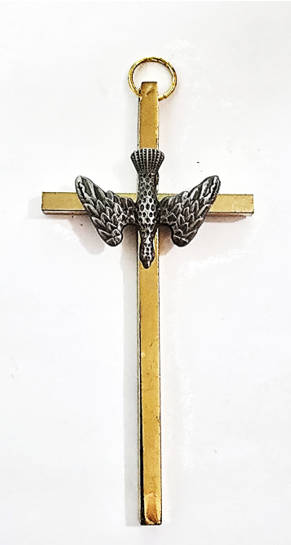
4cm Ankh / Crux Ansata Cross - Silver

4cm Ankh / Crux Ansata Cross - Silver

New 46 available
R15.00
Shipping
R65.00 Standard shipping applies to orders under R100.00, in most areas in South Africa. R35.00 Standard shipping applies to orders over R100.00. Some areas may attract a surcharge surcharge. This will be calculated at checkout if applicable.
Check my rate
The seller allows collection for this item. Buyers will receive the collection address and time once the order is ready.
The seller has indicated that they will usually have this item ready to ship within 3 business days. Shipping time depends on your delivery address. The most accurate delivery time will be calculated at checkout, but in general, the following shipping times apply:
 
Standard Delivery
Main centres:  1-3 business days
Regional areas: 3-4 business days
Remote areas: 3-5 business days
Seller
Buyer protection
Get it now, pay later

Product details

Condition
New
Location
South Africa
Product code
RPCR120
Bob Shop ID
667879967

Beautiful Ankh - Christian name is the "Crux Ansata Cross"

metal

4cm - nickel plated

Throughout human history, symbols have played a crucial role in communication, often representing complex ideas and beliefs succinctly. Two of the most enduring and significant symbols are the Egyptian Ankh and the Christian Cross. Despite their origins in vastly different cultures and time periods, both symbols share intriguing similarities and stark contrasts. This article delves into the history, meanings, and cultural significance of the Ankh and the Cross, exploring how they have influenced and been interpreted by their respective societies.

The Egyptian Ankh: Symbol of Life

Historical Context

The Ankh, also known as the "key of life" or "crux ansata" (Latin for "cross with a handle"), is one of the most recognizable symbols from ancient Egypt. It dates back to the Early Dynastic Period (c. 31502613 BCE) and became prevalent throughout the Old, Middle, and New Kingdoms.

Symbolism and Meaning

The Ankh is traditionally depicted as a cross with a loop at the top. It represents life and immortality, making it a potent symbol of existence, both earthly and eternal. The loop symbolizes the sun rising on the horizon, signifying eternal life, while the crossbar and the vertical line represent the physical and spiritual planes.

Use in Ancient Egypt

In Egyptian art, the Ankh is frequently seen in the hands of gods, pharaohs, and other figures of importance, symbolizing their life-giving power and divine protection. It is often shown being bestowed upon the lips of the deceased, granting them the breath of life necessary for the afterlife.

The Christian Cross: Symbol of Faith

Historical Context

The Christian Cross, particularly the Latin Cross, is the principal symbol of Christianity, representing the crucifixion of Jesus Christ and the redemption it brought to humanity. While the cross was used as a method of execution in the Roman Empire, it gained religious significance following the crucifixion of Jesus in the 1st century CE.

Symbolism and Meaning

The Cross is a potent emblem of sacrifice, salvation, and faith. Its vertical and horizontal bars symbolize the intersection of the divine and human realms. For Christians, it serves as a reminder of Jesus' suffering and the hope of resurrection and eternal life.

Use in Christianity

The Cross is ubiquitous in Christian worship and iconography. It appears on churches, altars, and personal jewelry. During religious ceremonies, it is often used in rituals such as the Eucharist and baptism, symbolizing the faith and devotion of the believers.

Comparing the Ankh and the Cross

Similarities

  1. Symbol of Life and Eternality: Both the Ankh and the Cross symbolize life. The Ankh represents physical and eternal life, while the Cross signifies spiritual salvation and eternal life through Christ.
  2. Cultural Importance: Each symbol holds a central place in its respective culture. The Ankh was a ubiquitous symbol in ancient Egyptian society, much like the Cross is in Christian culture today.
  3. Spiritual Connection: Both symbols represent a connection between the earthly and the divine. The Ankh connects the physical world with the eternal, while the Cross signifies the union of humanity with God through Jesus.

Differences

  1. Origin and Evolution: The Ankh originates from ancient Egypt, while the Cross is rooted in Roman execution methods and later adopted by Christians. Their historical contexts and paths to prominence are vastly different.
  2. Symbolic Emphasis: The Ankh emphasizes life and vitality in both the physical and afterlife realms. The Cross, however, focuses on sacrifice, redemption, and the promise of spiritual eternal life.
  3. Design and Iconography: Visually, the Ankh is distinct with its looped top, while the Cross is straightforward with its intersecting bars. Their designs reflect their unique cultural and religious meanings.

The Ankh's Influence on Modern Culture

Contempora...

Add to cart

Similar products

Don't miss out on the latest deals!