

| Main centres: | 1-3 business days |
| Regional areas: | 3-4 business days |
| Remote areas: | 3-5 business days |
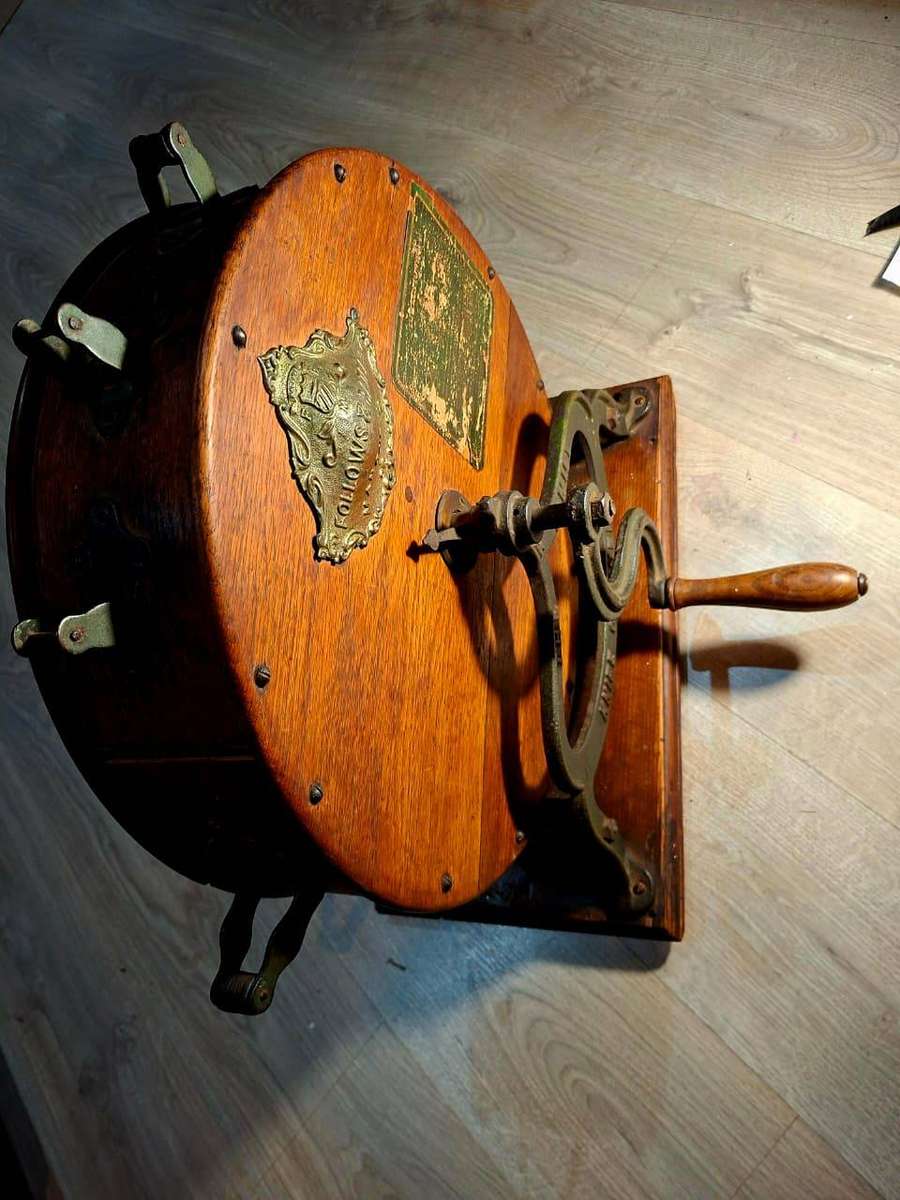
Description: A highly collectible, late-Victorian mechanical domestic appliance manufactured by the renowned engineering firm Follows & Bate Ltd. in Manchester, England (circa 1880s1900s). This rotary machine features a beautifully preserved, solid oak circular drum casing mounted onto a heavy cast iron framework painted in its original green finish. The front casting is clearly embossed with the model name: "THE FAMILY KNIFE CLEANER" along with the size designation "4". The face displays a decorative brass maker's plate featuring the company's shield trademark and text reading "Follows & Bate Ltd. Patentees, Manchester". Adjacent to the plate is the original green paper instruction label, detailing how to feed knives and use "Prepared Emery" powder to clean and sharpen carbon steel blades. It retains its original, curved S-shaped cast iron hand crank with a polished turned-wood handle.
Functionality: In the Victorian era, before the invention of stainless steel, household dinner knives were made of carbon steel, which tarnished, rusted, and stained rapidly. Knives were inserted blade-first into the brass-rimmed slots along the perimeter of the drum. Turning the hand crank rotated internal leather-bound pads and bristle brushes dusted with abrasive emery powder, cleaning, polishing, and sharpening the blades simultaneously.
The Good: The heavy cast-iron framework is structurally solid with crisp, highly legible raised relief lettering ("THE 4 FAMILY KNIFE CLEANER"). The central hand crank turns smoothly. The ornate brass manufacturer crest is beautifully preserved with a rich vintage patina. The original green paper instructional label on the side is partially intact (rare for these models, as they usually wear away completely).
The Wear: There is a notable structural age-split in the wood on the bottom base platform and typical peeling/weathering on the paper label.
Sold purely as a rustic collector's display piece.