

| Main centres: | 1-3 business days |
| Regional areas: | 3-4 business days |
| Remote areas: | 3-5 business days |
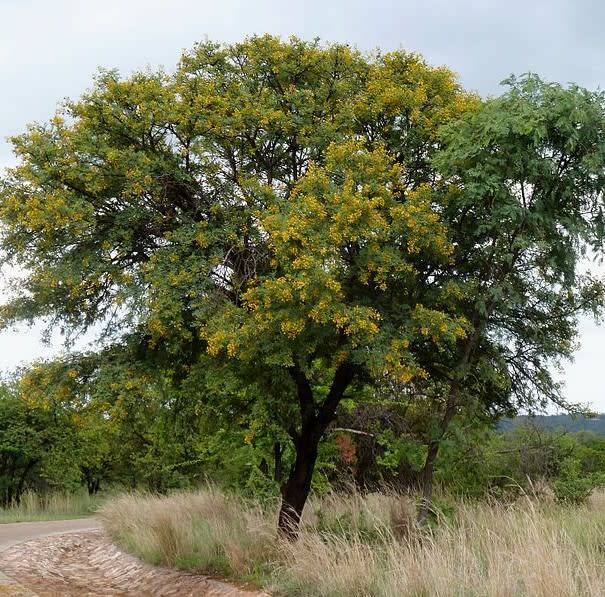
The blackthorn acacia (Senegalia mellifera) is a hardy, often thorny shrub or small tree native to arid and semi-arid regions of southern Africa, including South Africa, Namibia, Botswana, and surrounding areas. It is especially common in savanna and bushveld environments, where it forms dense thickets and plays an important role in natural grazing systems.
This species is easily recognised by its dense branching habit and sharp, paired thorns along the stems. The leaves are finely divided and small, helping reduce water loss in dry conditions. In spring and summer, it produces clusters of creamy-white, ball-shaped flowers that are highly attractive to bees and other insects. These are followed by flat, twisted pods that contain seeds and often remain on the plant for some time.
Senegalia mellifera is an important ecological species, providing cover and food for wildlife while also influencing grazing patterns in natural rangelands. It is known for its toughness and ability to regenerate after browsing or disturbance, which allows it to persist even under heavy grazing pressure. In some areas, it can form dense, almost impenetrable thickets.
Growing Senegalia mellifera is straightforward in hot, dry climates. It prefers full sun and well-drained soils, particularly sandy or rocky substrates. Once established, it is highly drought-tolerant and requires very little maintenance. It can tolerate poor soils but should be protected from prolonged waterlogging. Young plants may need protection from heavy frost, but mature specimens are resilient and long-lived under suitable conditions