


| Main centres: | 1-3 business days |
| Regional areas: | 3-4 business days |
| Remote areas: | 3-5 business days |
About the book:
Huxley's dystopia is more insidious than Orwell's no jackboots required when pleasure does the job.
A world of enforced happiness, soma-dulled contentment, and manufactured desire.
The one that mirrors the present, in the most interesting ways.
Vintage Penguin.
Condition:
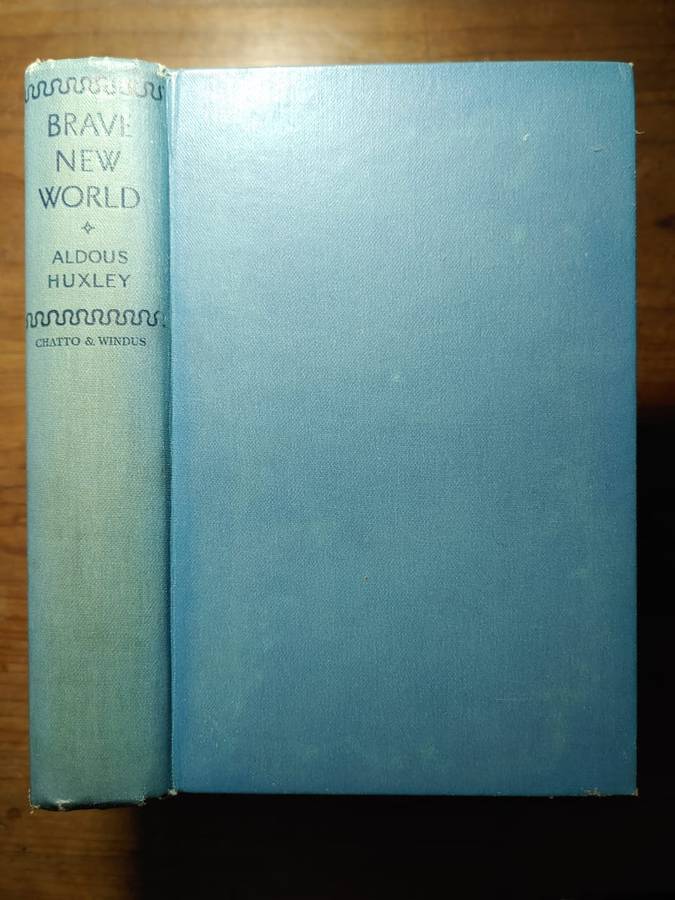
Wear to cover as pictured.
Age related tanning to pages.
All pages well bound and intact.
Follow the link below to view our other listings:
https://www.bobshop.co.za/seller/5375758/Orphan_Books
About the author:
Aldous Huxley (18941963)
Born in Surrey into one of the most intellectually distinguished families in English history his grandfather was T.H. Huxley, Darwin's greatest defender; his great-uncle Matthew Arnold; his brother Julian a biologist who became the first Director-General of UNESCO Huxley arrived in literature already saturated in scientific and humanist thought, and spent his career asking what both were actually for.
At sixteen a severe eye infection left him nearly blind for several years. He learned Braille, relearned to read with a magnifying glass, and retained permanently impaired sight. It seems to have concentrated rather than diminished him. He went to Oxford, moved through the London literary world of the 1920s producing sharp, satirical novels of ideas, then emigrated to Los Angeles in 1937 and never really came back to England or to the mode of fiction he'd been writing.
Brave New World (1932) sits between these two lives and transcends both. It is a dystopia built not on fear and force but on pleasure and contentment a World State where humans are decanted into conditioned castes, where soma dissolves unhappiness on demand, where consumerism is civic duty and Shakespeare is contraband. Written partly as a satirical riposte to H.G. Wells's technocratic optimism, its central argument has only grown more uncomfortable with time: that a society controlled through manufactured happiness is more stable, and more insidious, than one controlled through terror. Orwell read it and wrote 1984 in direct response two nightmare futures, one built on the boot, one on the pill. Neil Postman spent a book arguing Huxley was the one who got it right.
John the Savage, raised on Shakespeare in the Reservation and destroyed by his collision with the World State, is among the most painfully realised figures in twentieth century fiction the last person who insists on the right to be unhappy.
His influences include D.H. Lawrence, a close friend whose hostility to mechanisation runs beneath the novel's surface; Freud's pleasure principle; Ford's assembly line elevated to religion; and the eugenics debates crackling through the 1920s and 30s. His later work turned toward Eastern philosophy, mysticism, and psychedelics The Doors of Perception (1954), his account of a mescaline experience, gave Jim Morrison the name for his band and gave Timothy Leary and the entire psychedelic counterculture a founding text.
His influence on dystopian fiction is total: Bradbury, Dick, Atwood, and Burgess whose A Clockwork Orange is in direct conversation with Brave New World on the question of conditioned virtue all work in the space he opened. He died of cancer on November 22, 1963, the same day as Kennedy's assassination and C.S. Lewis's death, having requested and received an injection of LSD from his wife as he died. It was consistent.