
| Main centres: | 1-3 business days |
| Regional areas: | 3-4 business days |
| Remote areas: | 3-5 business days |
Mottramite forms in the oxidation zones of lead deposits, where vanadium-rich fluids interact with lead-bearing ores.
Later, calcite crystallizes out of carbonate-rich solutions that seep into these voids and fractures.
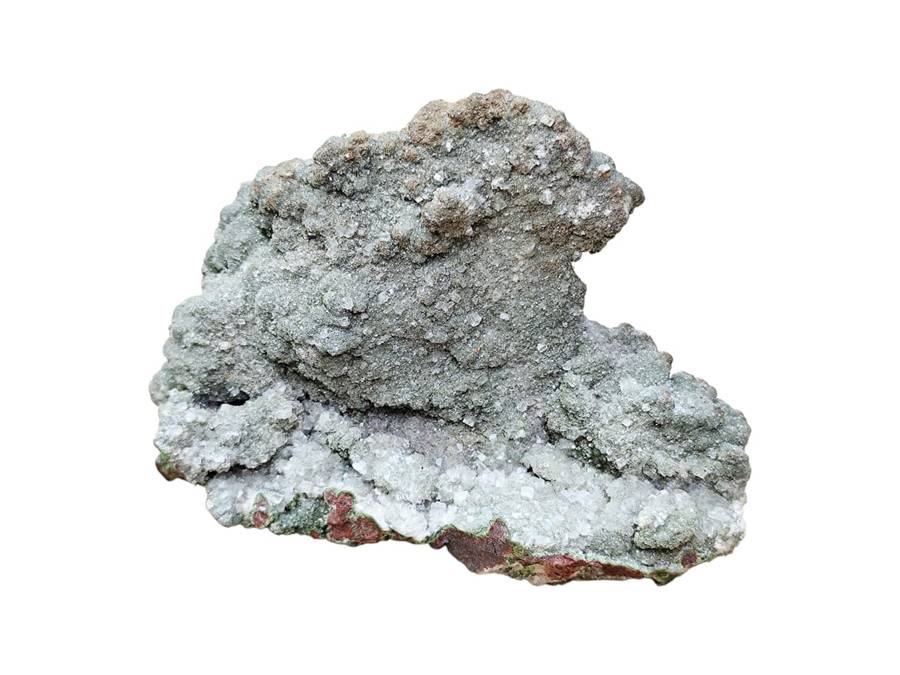
The result is a two-stage growth story: first the earthy, velvet-green mottramite base, then the crisp, sharp calcite perched elegantly on top.
This sequence captures Tsumeb's complex paragenesis, where dozens of mineralizing events layered minerals like a cake over millions of years.
Mottramite from Tsumeb is often botryoidal or fibrous, with a rich olive to blackish green color, sometimes velvety and lustrous.
Calcite, by contrast, grows in sharp, translucent to transparent rhombs, scalenohedrons, or blocky crystals.
Together, the textures contrast: soft velvet vs. hard sparkle, dark depth vs. bright clarity.
In a display case, these specimens pop instantly, often stealing attention from even more famous minerals like azurite or smithsonite.
In other localities, calcite is common and mottramite rare, but in Tsumeb the two met in extraordinary quality.
The perfection of crystal formclean calcite crystals sitting on a lush mottramite carpetis something that few other localities could ever replicate.
Tsumeb produced showcase specimens that are considered reference-grade worldwide.
For many, having Calcite on Mottramite is like ticking a box in the "Tsumeb Hall of Fame."
Alongside Azurite, Dioptase, Smithsonite, Wulfenite, and Cerussite, this pairing represents a unique side of the mine's mineral diversity.
Because it blends a "common" mineral (calcite) with a rare vanadate (mottramite), it has both familiarity and exclusivitya bridge between accessibility and rarity.
Every Tsumeb specimen is essentially a geological time capsule: the mine is closed, no more are being produced, and every piece carries with it a piece of mineralogical history.
Owning Calcite on Mottramite means holding not just a mineral but a chapter of Earth's story, forever frozen in crystal.
Tsumeb Mine in Namibia is one of the most famous mineral localities in the world.
It produced over 200 different mineral species, many of them unique or type-locality minerals.
For serious collectors, having representative specimens of the classic Tsumeb paragenesis is almost like owning chapters of mineralogical history.
Calcite on mottramite is one of those iconic associations that screams Tsumeb.
Calcite on Mottramite is one of those underrated Tsumeb treasuresovershadowed by azurite or dioptase in fame, but no less fascinating. For the discerning collector, it represents contrast, rarity, geological storytelling, and timeless beauty.