| Main centres: | 1-3 business days |
| Regional areas: | 3-4 business days |
| Remote areas: | 3-5 business days |
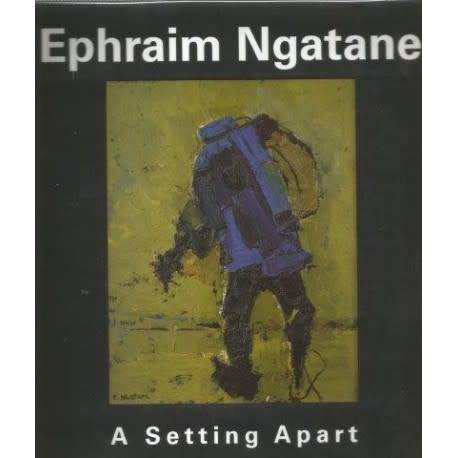
"EPHRAIM NGATANE: A SETTING APART" BY RORY BESTER, NATALIE KNIGHT AND DAVID KOLOANE. 2009 FIRST EDITION, 80 PAGES, HARDCOVER IN EXCELLENT CONDITION.
This first comprehensive introduction to Ngatanes oeuvre offers an intimate reflection on the artists tragically short life and showcases more than 80 of his most important works in public and private collections.
I will give you a few brief autobiographical details and take you to Soweto to meet his family and friends in order to add a human dimension to the drama. At the risk of sounding melodramatic, there have been several eerie and extraordinary co-incidences in my encounter with the Ngatane spirit, beginning with the date Johans has chosen for the book launch. This is the week that Ephraim was born on August 22,1938. On Sunday he would have been 73. Tragically Ephraim died before he reached the age of 33.
It was almost 2 years ago (on September 3rd 2008) that I arrived in Cape Town to meet Cecil Skotnes to talk about his student, Ephraim Ngatane. I felt Ngatanes presence palpably that afternoon. When I showed Cecil the pictures of Ephraims work, the floodgates of memory opened and Cecil seemed transported to the past. It was a precious afternoon, sitting in his studio, reminiscing about the old days. A few months later Cecil passed away, so I was grateful that I had been able to record his memories. So the first tribute tonight is to Cecil Skotnes Ngatanes teacher, and the man who meant so much to many of us in the art world. After completing high school in Soweto, Ngatane turned to the Polly Street Art Centre in downtown Johannesburg for his art education. Skotnes recalled that Polly Street was a place which flourished despite the rigors of Apartheid, and it was a place which discovered and nurtured the talents of many black artists who had nowhere else to go.
We soon discovered that painting was not just a hobby for Ngatane, but rather a way of life. I feel that Ngatane stood out amongst the other students because of his ability to use abstraction, and his desire to innovate with different techniques. I believe that Ngatane put his thumb print on South African art. he said
Skotnes opened several of Ngatanes exhibitions, and once Ngatane began exhibiting his work, his paintings quickly became sales successes. Black artists struggled under Apartheid, as they did not have regular jobs and therefore no passes. Most of Ngatanes contemporaries survived by selling their paintings for around R100 each, but Ngatanes artworks often went for more than R200 a piece at that time.
In 1964, Our humble homes became the first of Ngatanes artworks to be acquired by a public collection when it was bought by William Humphreys Art Gallery. Today, his works feature in a number of South Africas most prestigious public, private and corporate art collections. Ngatanes last exhibition before his untimely death in 1971 took place at the Champs Elysee Gallery in Hyde Park, Johannesburg. Bill Hargreaves, who opened the exhibition, remembers The gallery overflowed on the opening night with people on and under the steps. The paintings sold very well, some of them going for as much as R750.
To a small group of art lovers and collectors, Ngatane remained an important and valuable artist. His influence remained alive, as he had been responsible for teaching artists like Louis Maqubele, Dumile and others. He was always included in general publications and major group shows but there was no one source documenting his work. To the wider and younger art circle, he was unknown.
Thus, the second tribute of the evening is to Greg Blank, who recognized the need to produce a publication documenting Ngatanes life and artistic contribution, and set about to achieve this. Artist and writer, David Koloane, and I were invited to co-author the book with Rory Bester, who also served as the editor.
Greg recalled that he was a young boy of 8 or 9 when Ngatane and other artists used to come around to his home with their paintings wrapped in newspaper. Gregs father would always buy the paintings, and they acquired a large collection of his works. It was only when Greg was an adult that he began to appreciate the artists special qualities.
Although many artists of that time used the township as their subject matter, what set Ngatane apart was his approach he used abstract, geometric shapes, and a wide spectrum of colour to create compositions that are both aesthetically appealing, and emotive.
The style of Ngatanes work ranges from documentary realism to abstract painting, but it is always distinctively his own, and focuses on the gritty reality of township life.