

| Main centres: | 1-3 business days |
| Regional areas: | 3-4 business days |
| Remote areas: | 3-5 business days |
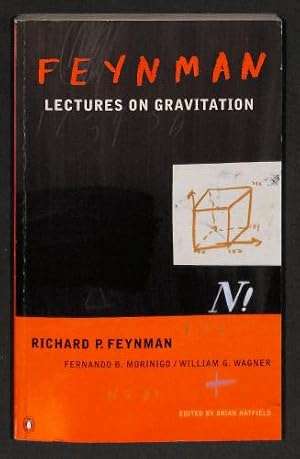
Penguin, 1999, softcover, illustrated, index, 230 pages, some slight wear to cover otherwise condition: basically as new.
Richard Feynman was the most brilliant and influential physicist of our time. Architect of quantum theories, enfant terrible of the atomic bomb project, caustic inquisitor on the space shuttle commission, ebulent bongo-player and storyteller - Feynman played a bewildering assortment of roles in the science of the post-war era. A brilliant interweaving of Richard Feynman's colourful life and a detailed and accessible account of his theories and experiments. Three of his books have been Pulitzer Prize and National Book Award finalists, and they have been translated into more than twenty languages.
Based on the in-class lectures of Richard Feynman, this book covers a wide range of topics in physics and provides a window to the thoughts of a brilliant Nobel laureate. The Feynman Lectures on Gravitation are based on notes prepared during a course on gravitational physics that Richard Feynman taught at Caltech during the 196263 academic year. For several years prior to these lectures, Feynman thought long and hard about the fundamental problems in gravitational physics, yet he published very little. These lectures represent a useful record of his viewpoints and some of his insights into gravity and its application to cosmology, superstars, wormholes, and gravitational waves at that particular time. The lectures also contain a number of fascinating digressions and asides on the foundations of physics and other issues. Characteristically, Feynman took and untraditional non-geometric approach to gravitation and general relativity based on the underlying quantum aspects of gravity. Hence, these lectures contain a unique pedagogical account of the development of Einstein's general relativity as the inevitable result of the demand for a self-consistent theory of a massless spin-2 field (the graviton) coupled to the energy-momentum tensor of matter. This approach also demonstrates the intimate a