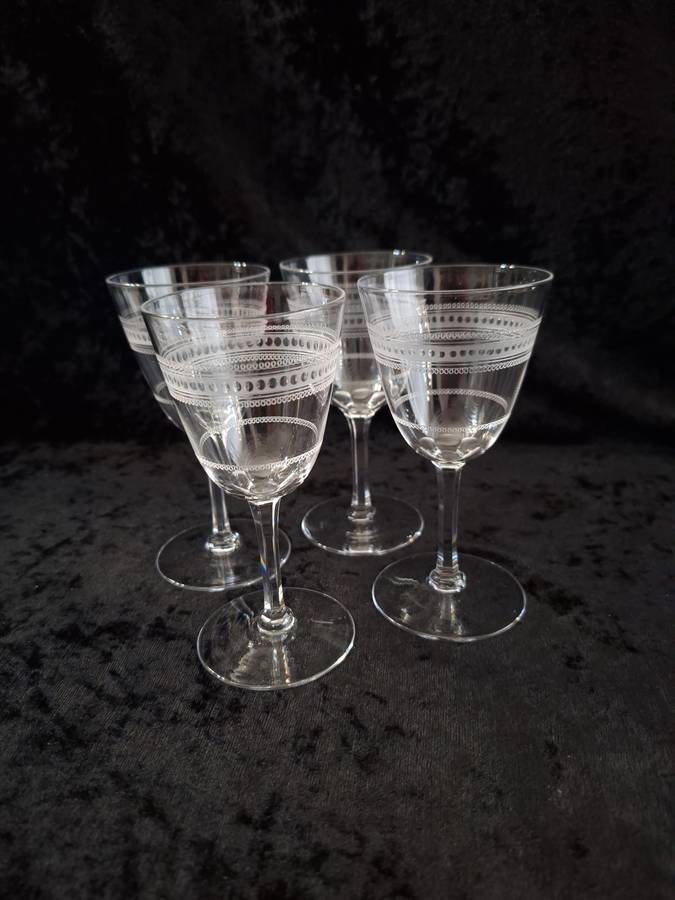
Description: Five antique Georgian Rummers Circa. 1810 -1820. Ref.GL-18
Make: Likely to be English
Date: Estimated date 1810 1820
History: Square-footed Rummers were popular in Britain during the late Georgian period around 1790 to 1830. They were hand-blown, sturdy, heavy, and very stable. The wheel engraving decoration was simple to begin with but peaked around the early 19th century. However, the square base was also subject to bad chipping, and, over the years they had to be re-ground and re-polished numerous times, often leading to slight differences in the size of the foot as well as to the height of the Rummer. Because of this, the square foot was phased out. Around the 1810s, the thickness of the glass bowl increased slightly and the square foot showed an absence of the pontil mark. This was because the base was pressed into a metal cast whilst the glass was still fluid. However, the bowl still had to be fused to the base and small bubbles and swirl marks are usually visible at the junction. The earlier soda-glass which had a slightly grey tone was replaced by a clearer lead-glass which gave a higher ring tone. Many drinking glasses were sent to the Netherlands, Bohemia and Austria for engraving as it was said that the quality of the engravings were better.
Description: There are five Rummers in all, each with slightly different dimensions due to being hand-blown as well as having been re-polished, possibly many times over. The wheel engraving on each Rummer shows five flowers depicted as a frame. Within the frame, two Rummers show a dancing couple, whilst the remaining three engravings show a male figure holding a cane and a female figure holding an umbrella. Now comes the interesting part the flowers in the engravings appear to be the Edelweiss flower which is the national symbol of Austria, Switzerland, Bulgaria, Italy and Slovenia. Edelweiss Day is celebrated on the 5th March, and, according to tradition, giving the flower to a loved one is a promise of dedication and love. Thus the one scene is of a younger dancing couple, the other scene depicting them in later years. Look at the traditional folk attire on the figures typical of Austria and surrounding countries. This points to the possibility of the glasses, although made in England, were sent to Austria for engraving and possibly presented as a wedding gift.
Condition: All Rummers remain in good condition and all show re-polishing of the square foot. One Rummer shows two chips to the underside. The engravings differ slightly from each other, evidence of hand engraving. Bubbles and swirl marks are also evident. No chipping to the rims (possibly re-ground and re-polished?)
Dimensions: Height 9.5cm, 9.0cm, 9.6cm, 9.6cm, 9.6cm
Width 7.2cm, 7.0cm, 7.0cm, 7.3cm, 7.2cm
Width of Square Foot 4.8 x 4.9cm, 4.8 x 4.9cm, 4.6 x 4.8cm, 5.4 x 5.5cm, 4.9 x 4.9 cm (this last Rummer shows two chips to the underside of the foot).
For comparison.always check Google for comparisons of price, etc.
Price: R 1500.00
Please note, I am NOT a qualified archaeologist/antiquarian and the description I have given is based on research of the subject.
This is a genuine antique. Please remember the classification of an 'antique' is that it should be 100 years old, OR MORE.
Terms: We offer a strict three-day approval period from the date the parcel reaches you. Refunds/credits are based on the cost of the article, NOT including delivery charges. Please advise us within this period whether you would like to return any article for a refund/credit. Although we pride ourselves in our packing, the buyer remains responsible for loss, non-arrival or damage to goods being sent to, or returned.