| Main centres: | 1-3 business days |
| Regional areas: | 3-4 business days |
| Remote areas: | 3-5 business days |
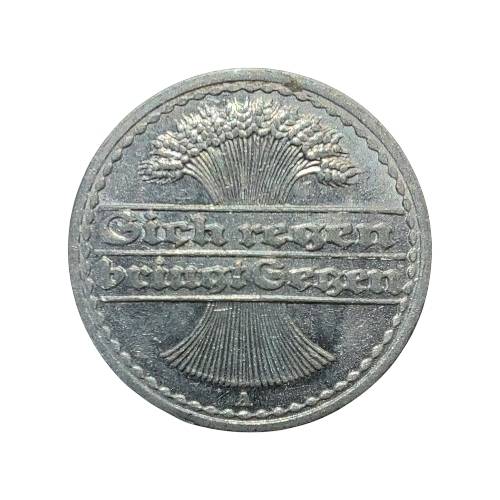
The 1921 German 50 Pfennig coin was issued during the early years of the Weimar Republic, a period marked by political upheaval and economic instability following the end of World War I. This coin reflects Germany's transition from imperial rule to a democratic republic.
The obverse features the denomination "50 PFENNIG" prominently displayed within a simple yet bold design, accompanied by the date 1921. The minimalist style reflects the practical approach to coinage during a time when Germany was facing increasing financial pressure and inflation.
The reverse displays the German national eagle, symbolising the authority of the new republic. The inscription "DEUTSCHES REICH" appears above, identifying the issuing state. Unlike later issues, the eagle design used during this period is more traditional and less stylised than those seen in subsequent regimes.
Coins such as this were struck in base metal due to economic constraints and were widely circulated in everyday transactions. The early 1920s would soon see the onset of severe hyperinflation in Germany, making coins like this part of a rapidly changing monetary landscape.
Today, the 1921 50 Pfennig coin is collected as a historical piece from the Weimar era, representing one of the final periods before Germany's currency system underwent dramatic changes.
Country: Germany (Weimar Republic)
Year: 1921
Denomination: 50 Pfennig
Catalogue: KM#27
Composition: Aluminium
Weight: approx. 1.3 g
Diameter: approx. 23 mm
(MB 28)