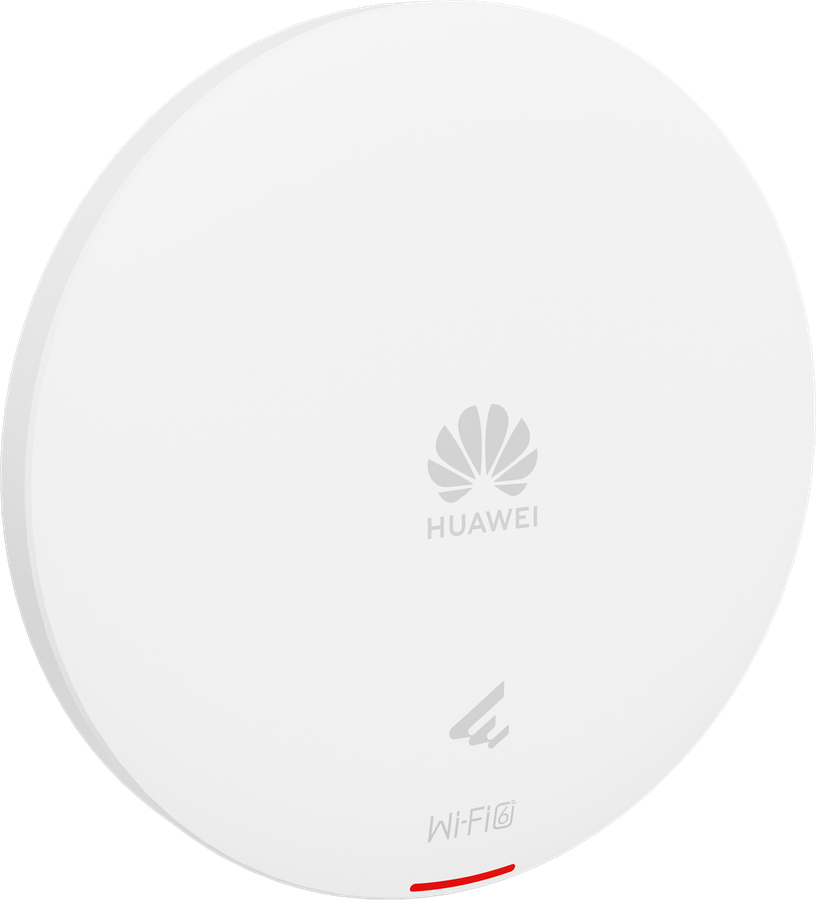
Huawei eKitEngine AP160 11ax Wi-Fi 6 Indoor Dual Band Access Point 50086816
Huawei eKitEngine AP160 is a Wi-Fi 6 (802.11ax) wall plate 86x86 access point (AP) with an 8 mm ultra-thin panel. It provides services simultaneously on the 2.4 GHz (2x2 MIMO) and 5 GHz (2x2 MIMO) frequency bands, achieving a maximum device rate of 1.775 Gbps. This AP features high bandwidth, high concurrency, and compact size, facilitating flexible deployment and saving customer investment. It is ideal for indoor coverage scenarios such as enterprise workplaces, commercial real estates, and budget chain hotels.
Features:
Wi-Fi 6 (802.11ax) standard
- As the latest Wi-Fi standard defined in IEEE 802.11, 802.11ax improves the user access capacity and bandwidth in high-density access scenarios, reducing service latency and enhancing user experience.
- 802.11ax supports multi-user multiple-input multiple-output (MU-MIMO) on both the 2.4 GHz and 5 GHz frequency bands, allowing an AP to transmit data to and receive data from multiple STAs simultaneously and multiplying the utilization of radio spectrum resources.
- 802.11ax supports 1024-quadrature amplitude modulation (QAM), improving data transmission efficiency by 25% compared with 802.11ac (supporting 256-QAM).
- Orthogonal frequency division multiple access (OFDMA) technology enables the AP to transmit data to multiple STAs at the same time using different subcarriers, reducing latency and improving network efficiency.
- Spatial reuse (SR) technology uses basic service set (BSS) coloring to enable APs and STAs to distinguish overlapping BSSs, minimizing co-channel interference.
MU-MIMO
The AP supports MU-MIMO and a maximum of four spatial streams, two spatial streams at 2.4 GHz and two spatial streams at 5 GHz. The MU-MIMO technology enables an AP to send data to multiple STAs simultaneously, which doubles the radio spectrum resource usage, increases the number of access users and bandwidth, and improves user experience in high-density access scenarios.
High-speed access
The AP supports 80 MHz frequency bandwidth, which increases the number of available data subcarriers and extends transmission channels. In addition, the AP uses 1024-QAM and MU-MIMO technologies to achieve a rate of up to 0.575 Gbps on the 2.4 GHz frequency band and 1.2 Gbps on the 5 GHz frequency band, and 1.775 Gbps for the device.
High Density Boost technology
Huawei uses the following technologies to address challenges in high-density scenarios, including access problems, data congestion, and poor roaming experience:
5G-prior access
The AP supports both 2.4 GHz and 5 GHz frequency bands. The 5G-prior access function enables the AP to steer STAs to the 5 GHz frequency band preferentially, which reduces loads and interference on the 2.4 GHz frequency band, improving user experience.
Wired and wireless dual security guarantee
To ensure data security, Huawei APs integrate wired and wireless security measures and provide comprehensive security protection.
Authentication and encryption for wireless access
The AP supports WEP, WPA/WPA2-PSK, WPA3-SAE, WPA/WPA2-PPSK, and WPA/WPA2/WPA3-802.1X authentication/encryption modes to ensure wireless network security. The authentication mechanism is used to authenticate user identities so that only authorized users can access network resources. The encryption mechanism is used to encrypt data transmitted over wireless links to ensure that data can only be received and parsed by authorized users.
Wired access authentication and encryption for the AP
Automatic radio calibration
Automatic radio calibration allows an AP to collect signal strength and channel parameters of surrounding APs and generate an AP topology according to the collected data. Based on the interference caused by authorized APs, rogue APs, and non-Wi-Fi interference sources, and their loads, the AP automatically adjusts its transmit power and working channel to make the network operate at the optimal performance. In this way, network reliability and user experience are improved.
Cloud-based management
The AP supports cloud-based management. It provides various authentication functions, such as PSK, Portal, SMS, and social media authentication, without the need of a WAC or an authentication server. This greatly simplifies networking and reduces CAPEX. In addition, the AP can be deployed on a cloud management platform to implement cloud-based network planning, deployment, inspection, and O&M. In multi-branch deployment scenarios, after cloud APs are pre-configured on the cloud management platform, deployment personnel only need to power on the cloud APs on site, connect them to network ports of switches, and scan their QR codes to implement the plug-andplay function. Then the pre-configurations are automatically delivered to the APs. This mode greatly accelerates network deployment. The cloud management platform can monitor the network status, device status, and STA connection status at all sites of tenants in a comprehensive and intuitive manner.
Deployment and O&M through HUAWEI eKit app
The HUAWEI eKit app supports deployment through Wi-Fi, barcode scanning, and leader AP. After the deployment is complete, more project maintenance operations can be performed on the HUAWEI eKit app.
Wi-Fi-based deployment
Wi-Fi-based deployment is a fast deployment mode provided by the HUAWEI eKit app. With this function, you can connect your mobile phone to the management Wi-Fi network of an AP and deploy network projects. In this way, devices can be automatically onboarded and remotely managed on the app.
Barcode scanning-based deployment
In addition to Wi-Fi-based deployment, the HUAWEI eKit app also provides the barcode scanning-based deployment function. With this function, you only need to scan the SN on the device chassis and synchronize the information to the Huawei eKit system to onboard the device. Barcode scanning-based deployment is ideal for the following scenarios:
Devices in a network project have been deployed through Wi-Fi, and some devices need to be added to this project for capacity expansion.
The device version does not support Wi-Fi-based deployment but supports barcode scanning-based deployment, and you want to deploy the device without upgrading the device version first.
Leader AP-based deployment
- The leader AP function is an extended function of Fat APs. Like a WAC, a Fat AP enabled with the leader AP function can be deployed to build a WLAN together with multiple Fit APs. On this WLAN, the Fat AP manages and configures the Fit APs in a unified manner, enabling ...