| Main centres: | 1-3 business days |
| Regional areas: | 3-4 business days |
| Remote areas: | 3-5 business days |
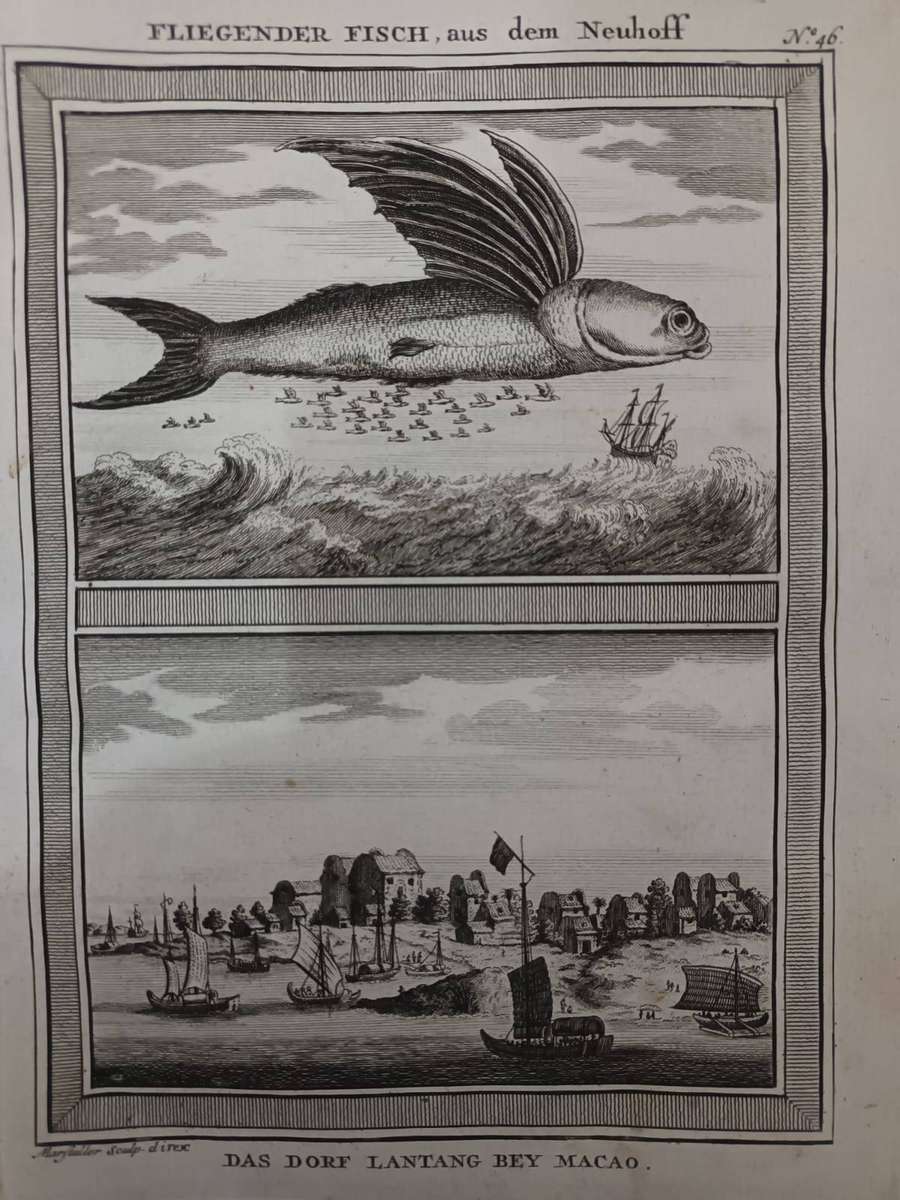
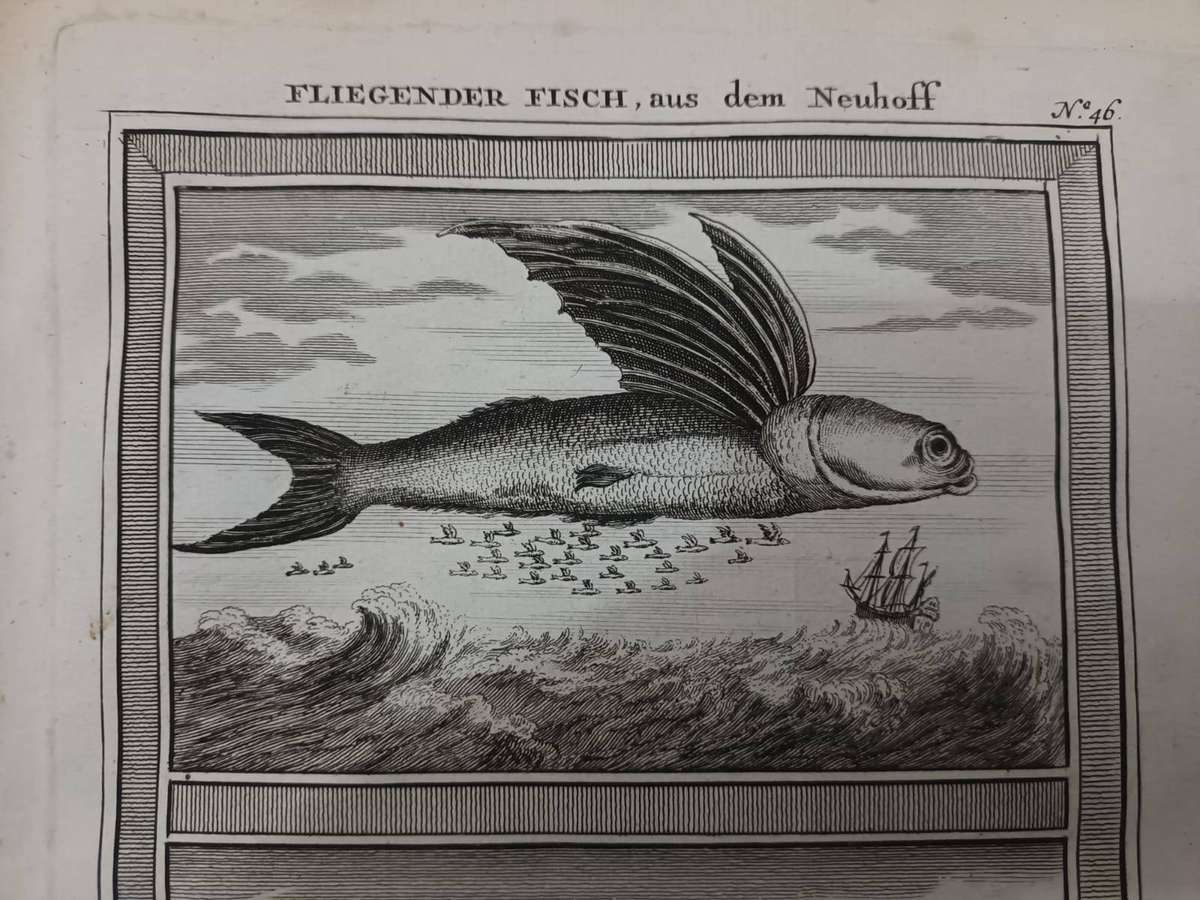
Antiquarian copperplate engraving, titled "Fliegender Fisch" (Flying Fish) and "Das Dorf Lantang bey Macao" (Lantang village near Macao). Published in Leipzig, 1750. It is based upon the 17th century illustration by Dutchman, Johan Nieuhof's. It features two distinct copperplate engravings:
Top Illustration: "Fliegender Fisch" (Flying Fish)
Subject: A fantastical depiction of a flying fish gliding over the ocean, accompanied by a fleet of smaller fish and a sailing vessel in the background.
Context: Johan Nieuhof was a Dutch traveler who worked for the Dutch East India Company. His observations of exotic wildlife were often stylized by European engravers, leading to the slightly "monstrous" or exaggerated appearance seen here.
Text: "FLIEGENDER FISCH, aus dem Neuhoff" translates to "Flying Fish, from Nieuhof."
Bottom Illustration: "Das Dorf Lantang bey Macao"
Subject: A coastal view of the village of Lantang near Macau (modern-day China).
Details: The scene shows traditional regional architecture and various sailing junks in the harbour. This served as an early ethnographic record for European audiences curious about East Asian landscapes.
Historical Significance
This specific sheet (labeled No. 46) comes from Allgemeine Historie der Reisen zu Wasser und Lande (1750). These prints are highly collectible for their blend of historical exploration and antique artistic style.
Description: Copperplate engraving, plate-mark area measurement approximately 20 x 14cm, uncoloured, blank verso.
Condition: Some grubbiness in the margins (see image). This image would frame nicely.
Provenance: I acquired this from an Austrian dealer some years ago. It comes from the sixth volume of Allgemeine Historie der Reisen zur Wasser und zu Lande ("General History of Voyages by Sea and Land") published in Leipzig in 1750. Allgemeine Historie der Reisen zu Wasser und zu Lande was one of the most ambitious travel compilations of the European Enlightenment. Published in Leipzig between 1747 and 1774 in twenty-one substantial volumes and edited by Johann Joachim Schwabe, it formed part of an international publishing enterprise that drew upon earlier English and French collections of voyages, particularly the works associated with John Green and Antoine François Prévost. Intended to provide German readers with a comprehensive account of the known world, the series assembled travel narratives, geographical descriptions, ethnographic observations, maps, and illustrations relating to Europe, Asia, Africa, and the Americas. Appearing during an age of expanding global exploration and commercial exchange, it served both as a reference work and as a vehicle for Enlightenment curiosity about foreign peoples, landscapes, religions, and customs. The Allgemeine Historie became one of the most important German-language repositories of travel knowledge in the eighteenth century, reflecting contemporary efforts to organise and disseminate information about the wider world in a systematic and scholarly form.