Penguin Classics, 1995, softcovers, condition: new.
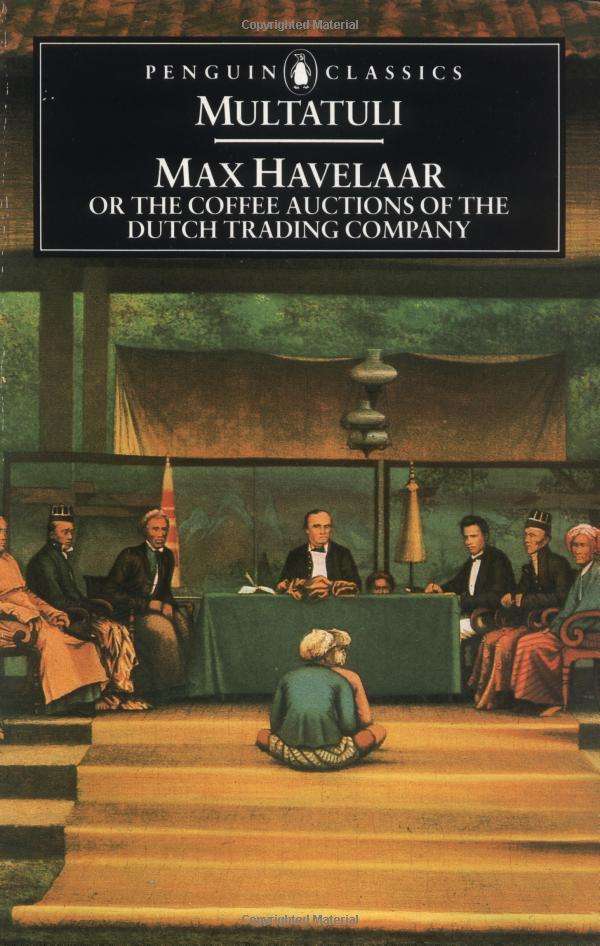
Max Havelaar - a Dutch civil servant in Java - burns with an insatiable desire to end the ill treatment and oppression inflicted on the native peoples by the colonial administration. Max is an inspirational figure, but he is also a flawed idealist whose vow to protect the Javanese from cruelty ends in his own downfall. In Max Havelaar, Multatuli (the pseudonym for Eduard Douwes Dekker) vividly recreated his own experiences in Java and tellingly depicts the hypocrisy of those who gained from the corrupt coffee trade. Sending shockwaves through the Dutch nation when it was published in 1860, this damning exposé of the terrible conditions in the colonies led to welfare reforms in Java and continues to inspire the fairtrade movement today.
This book is like an onion. It is based on the collected writings of a certain Max Havelaar, a Dutch assistant-governor of the former colony of Java. His writings, originally in German, are translated by the young student Stern, who resides as a guest in Amsterdam, in the house of the selfish coffe tradesman Droogstoppel. It is this character, Droogstoppel, that supposedly tells the reader the different stories.
I have no idea why Multatuli chose this multi-layered technique. It does however allow him to write an extremely strong ending, where the author suddenly emerges from the complexity of the interweaving versions and boastfully proclaims all his characters to
be nothing but fictions, created by him. Then he tells them to shut up while he, Multatuli, takes up the pen and addresses the Dutch people and the king directly, to put an end to the misery and the abuse of the native Javan population. One could say he has his Prospero moment.
Max Havelaar's story is almost literally based on the real experiences by Eduard Douwes Dekker, who was an assistant-governor who protested against the abuses and was as a result kicked out of his job. With this book he gets back at the people who are responsible for the injustice. And it worked; after the publication public opinion was appalled, measures were taken and when Holland lost the Indonesian colonies during the World Wars, it remained a sensitive point up to this day that they never really got the chance to set right the wrongs that were committed.
The Dutch sometimes nominate Max Havelaar as the best book written in their language. That certainly isn't true and I wouldn't recommend anyone to read it for fun! However, it may be one of the most important books ever written, because it actually changed things for the better. I believe Marx somewhere says that "philosophers have interpreted the world, but that the important thing is to change it". That, at least, is something that Max Havelaar has done.
Colonialism has had a bad press since the sixteenth century. The problem in such unanimity of opinion, few ever bother to explain exactly how it creates such misery. It this remarkable work which is not a true a novel is the expose of a failing colonial system. Using the pen name of Mutlatuli, Eduard Douwes Dekker, a former dutch colonial administrator explained in great deal how the Dutch colonial administration worked and why it was failing.
1 the Dutch forced their colonies to produce crops for exports so as to generate generate revenues for the home country. Staple crops were neglected creating poverty and starvation in the colonies which had ample quantities of arable with which to feed their populations
2 the prices of export crops fluctuated wildly, which meant that the export crops could not be relied on to finance the development of an industrial infrastructure (electricity, public water supplies, ports, trains, etc.) Consequently the colonies failed to industrialize
3 finally taxation of the colonies was excessive significantly compounding the problems created the export oriented economy.
Modern economic historians whether on the right or the left all agree with Multatuli that directing a colonial's agricultural resources into the production of export crops inevitably created poverty and prevented industrialization n the colonies. American industrialized in the north, the farmers produced for a local market. The South which produced cotton for export did not. Max Havelaar is well written although highly didactic novel about 19th century European materialism that has stood the test of time well. Most of the problems Dekker described still exist in various places through out our planet. Reading his book is great way to start to understand the factors preventing economic growth in the third world.
After finishing this, you might want to read Iceland's Bell by Halldor Laxness which shows many of the problems described by Dekker for Dutch Indonesia also existing in Denmark's North Atlantic colony.