| Main centres: | 1-3 business days |
| Regional areas: | 3-4 business days |
| Remote areas: | 3-5 business days |
Status:
Complete and Play Tested
----------------------------------
Developer: DICE
Publisher: Electronic Arts
Genre: First-Person Action / Parkour
Release: 2016
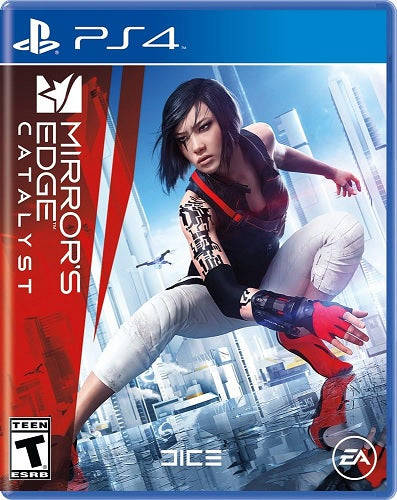
Mirrors Edge Catalyst is a stylish reboot of the original cult classic, expanding its signature first-person parkour into an open-world city. On PS4, it delivers fluid movement, a striking visual identity, and exhilarating traversal but struggles with repetition, weak combat, and a diluted sense of focus.
At its core, Catalyst is built around free-running and momentum-based traversal, and this is where the game truly shines. Faiths movement wall-running, sliding, vaulting, and chaining parkour moves feels smooth and satisfying when everything clicks.
The game emphasizes:
Flow and speed over combat
Precision movement and route optimization
Environmental awareness and timing
When missions are designed tightly, the gameplay becomes exhilarating, rewarding players who master movement and maintain momentum ().
However, combat is a clear weak point. While it focuses on evasion and mobility, forced encounters disrupt flow and feel awkward or underdeveloped ().
The addition of a skill tree adds progression but can feel unnecessary, especially when basic movement abilities are locked behind upgrades.
Catalyst introduces an open-world city (Glass), a major shift from the linear design of the original. The environment is visually stunning a clean, minimalist skyline filled with glass towers and bold color accents.
Exploration includes:
Side missions and delivery runs
Time trials and movement challenges
Hidden routes and collectibles
While the city is beautiful, the open-world structure is a mixed success. It offers freedom but lacks meaningful variety, and side activities can feel repetitive (). The game is often at its best in focused, linear missions where movement and level design align perfectly.
The story follows Faith Connors, a runner fighting against a corporate-controlled dystopian society. Themes include:
Surveillance and control
Freedom vs authority
Identity and rebellion
While the premise is compelling, execution is uneven. The narrative and characters are often considered forgettable or underdeveloped, serving more as a backdrop for gameplay than a driving force ().
On PS4, Catalyst stands out with:
Clean, minimalist art direction
Bright, high-contrast environments
Smooth animations that enhance movement flow
The city of Glass is visually striking, combining sterile whites with bold color highlights to guide players naturally through the environment. Performance is generally stable, supporting the fast-paced traversal.
The soundtrack features ambient electronic music that complements the futuristic setting and sense of motion. Audio design enhances immersion, with subtle cues for movement and environmental interaction.
Voice acting is solid, though not particularly memorable, aligning with the games overall narrative tone.
Catalyst offers:
Main story campaign
Side missions and challenges
Time trials and leaderboard competitions
Replay value comes from:
Improving run times
Discovering optimal routes
Competing on leaderboards
However, repetitive side content and limited gameplay variety can reduce long-term appeal.
Excellent parkour and fluid movement mechanics
Beautiful, minimalist open-world design
Strong sense of speed and momentum
Rewarding time trials and skill-based challenges
Unique gameplay compared to other action games
Weak and often intrusive combat
Open-world design lacks variety and focus
Story and characters are underwhelming
Repetitive side missions and objectives
Progression system can feel unnecessary
Mirrors Edge Catalyst on PS4 is a visually stunning and mechanically satisfying parkour experience that excels when it focuses on movement but stumbles with its open-world structure, combat, and narrative depth.
Its a game of highs and lows: when youre sprinting across rooftops in perfect flow, it feels incredible but those moments are sometimes diluted by repetitive design and underwhelming systems.
Score: 7.5 / 10