Operational Logistics
Check my rate
View locations
| Main centres: | 1-3 business days |
| Regional areas: | 3-4 business days |
| Remote areas: | 3-5 business days |
| Main centres: | 1-3 business days |
| Regional areas: | 3-4 business days |
| Remote areas: | 3-5 business days |

2027Textbooks is the academic division of ReadMatter Bookshop. Building on our years of experience in the book industry, we have partnered with leading publishers to offer more than 30,000 academic and contemporary titles.
Every book is brand new and ordered on demand directly from the publisher once your order is placed. Due to the size of our catalogue, we do not keep these titles in stock.
Please allow up to 15 working days for dispatch. In the rare event that a title is temporarily out of stock at the publisher, the lead time may be longer. We will contact you if this affects your order.
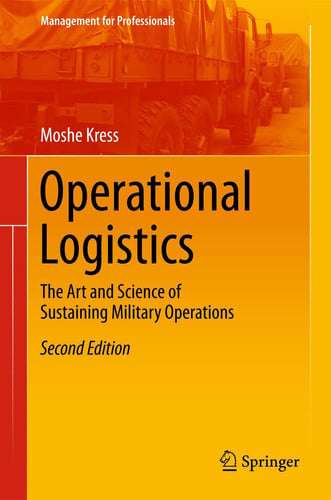
This book explores the theoretical foundations and applications of military operational logistics (OpLog). OpLog theory has two facets: qualitative and quantitative.The qualitative facet is imbedded in the theory of operational level of war or operational art. It includes principles, imperatives and tenets, which are stated and analyzed in the first few chapters. The quantitative facet relates to the scientific aspects of OpLog. It is manifested by formal network models representing structural and operational features of an OpLog system. The book examines the two facets and integrates them into a unified presentation. Important OpLog applications a re described and discussed.
Chapter 1 presents a general introduction to military logistics. Chapter 2 discusses the px;font-family: monospace;">general structure and characteristics of logistics and describes its three levels ��� strategic, operational and tactical. Chapter 3 describes the foundation of OpLog. Chapter 4 deals with OpLog planning. Chapter 5 addresses the issue of logistic information, and Chapter 6 deals with forecasting logistic demands. Chapters 7 and 8 are new additions to this second edition. They address logistics aspects of two contemporary operational topics ��� insurgencies and humanitarian assistance.Chapter 9 describes the first version of the logistic network model. Chapter 10 addresses an important OpLog characteristic ��� Flexibility. Chapter 11 discusses two major challenges in OpLog practice: force accumulation, 4419px; font-family: monospace;">and medical treatment and evacuation. Chapter 12 presents an inter-temporal network optimization model designed to determine deployment and employment of 3333px;font-family: monospace;">the OpLog support chain during military operations.