This item has closed 1 buyer bought 2 items
View other items offered by FaiRy GarDeN8759

Similar products

QUEENSLAND ARROW ROOT / ACHIRA / CANNA EDULIS -   5 BULBS QUEENSLAND ARROW ROOT / ACHIRA / CANNA EDULIS -   5 BULBS
Sold

QUEENSLAND ARROW ROOT / ACHIRA / CANNA EDULIS - 5 BULBS

New 2 were available
R23.00
Shipping
Free shipping is available from FaiRy GarDeN for all orders above R1,500.00, using one of our trusted couriers.
Check my rate
The seller has indicated that they will usually have this item ready to ship within 5 business days. Shipping time depends on your delivery address. The most accurate delivery time will be calculated at checkout, but in general, the following shipping times apply:
 
Standard Delivery
Main centres:  1-3 business days
Regional areas: 3-4 business days
Remote areas: 3-5 business days
Buyer protection
Get it now, pay later

Product details

Condition
New
Location
South Africa
Bob Shop ID
673932432

Canna edulis, widely known as Achira or Queensland Arrowroot, is a versatile perennial plant native to the Andes of South America. While often grown for its lush, tropical foliage and vibrant red flowers, it has been a significant food crop for thousands of years. 
 It is the only domesticated edible species in the Cannaceae family. Nearly all parts are edible:
Rhizomes (Roots): Large, starchy tubers (up to 60 cm long) that can be eaten raw, boiled, or baked like a potato.
Young Shoots: Cooked as a green vegetable similar to asparagus.
Immature Seeds: Sometimes ground and added to tortillas.
Nutrition: The rhizomes are a source of highly digestible starch, making them ideal for infants, the elderly, and those with digestive issues. They are also high in potassium and contain 10-12% protein on a dry-weight basis.
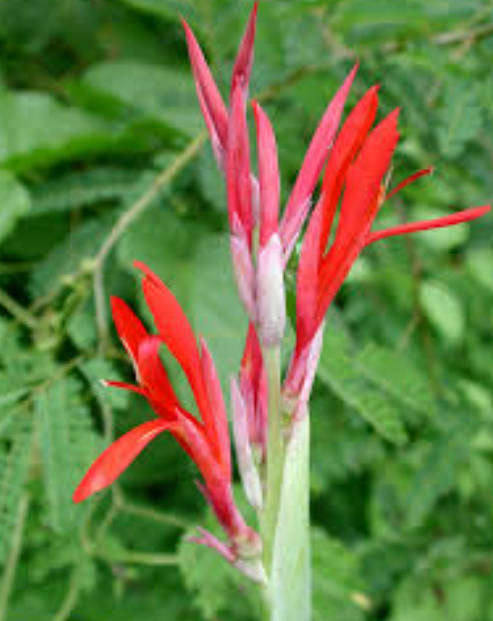
Appearance: It grows 1.5 to 3 metres tall with large, lance-shaped green or purple-edged leaves and small, bright red flowers.
Cultivation: It thrives in warm, moist climates and is remarkably pest-resistant. It is often used in permaculture as a "chop and drop" mulch plant or windbreak. 
Ancient Staple: Archeological evidence shows Achira was cultivated in Peru as far back as 20003000 BCE and was even buried with the dead in ancient graves.
"Indian Shot": One of its common names comes from its incredibly hard, round, black seeds. They are so dense they sink in water and were reportedly used as lead shot in 18th-century flintlock guns when soldiers ran out of bullets.
Record-Breaking Starch: Achira produces the largest starch granules known in the plant world, which are large enough to be seen with the naked eye.
Ancient Seeds: The seeds have an extremely hard coat, allowing them to remain viable for centuries. Some seeds recovered from archaeological sites were successfully germinated after nearly 600 years.
Modern Uses: Beyond food, its starch is used to make cellophane noodles in Vietnam (known as min dong) and biodegradable plastics in China.
Ecological Filter: The plant has a high tolerance for contaminants and is used in constructed wetlands to purify greywater and extract industrial pollutants.