

| Main centres: | 1-3 business days |
| Regional areas: | 3-4 business days |
| Remote areas: | 3-5 business days |
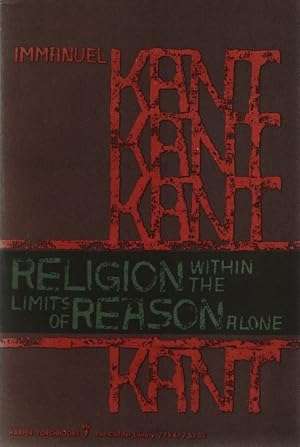
A Monumental Figure of Western Thought Wrestles with the Question of God: Immanuel Kant (1724-1804) is one of the most influential philosophers in the history of Western philosophy. His contributions have had a profound impact on almost every philosophical movement that followed him. His teachings on religion were unorthodox in that they were based on rationality rather than revelation. Tho logically proving God's existence might be impossible, it's morally reasonable to "act as if there be a God." His strictly rational approach was considered so scandalous that the King of Prussia forbid him to teach or write further on religious subjects, which Kant obeyed until the king's death. A work of major importance in the history of Western religious thought, Religion Within the Limits of Reason Alone represents a great philosopher's attempt to spell out the form & content of a type of religion grounded in moral reason & meeting the needs of an ethical life.
Immanuel Kant undertakes this work, which is both enormously challenging and worthy. It is about trying to place religious thought and the feeling of religiosity within the scope of human rationality. Religion within the limits of Simple Reason is a work that aims to unveil the rational mechanisms that engender the perception of divinity, discarding, however, the direct interventions of God and the hypotheses linked to divine enlightenment by the work of the Holy Spirit, by Due or by His angels and Saints. In his investigations, the author assumes that the duality of existence represents a balance between good and evil. It fundamentally affects the individual, and only through inner clarification can man understand his role in the face of the universal struggle between good and evil, which is present in the world and within it. Throughout his book, he demonstrates that a dual principle exists in all monotheistic religions. Yet, when compared, all these religions reveal common characteristics, suggesting ways to harmonize humanity with nature and God.
In short, Kant aims in this work to demonstrate that the experience of religiosity and contemplative ecstasy is also possible through the path of rational enlightenment and philosophical speculation, focusing on the study of sacred works, especially those concerning monotheistic religions and, even more closely, Christian faiths. To this end, it indicates ways of seeking divinity and "enlightenment" based on logical reasoning.