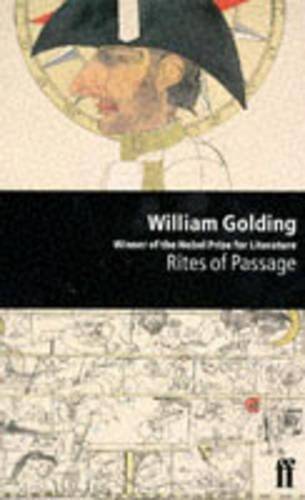
William Golding's Rites of Passage is one of those books you can't say much about, since it ruins the tale. On surface, it is about Edward Talbot's voyage to Australia in 1812. Talbot is a pompous young man, and aristocrat, who happens to keep a detailed journal. As the pages go by, you see glimmerings of maturity, and a sure eye for recording details.
The book starts out in a comic vein, one that had me thinking early on of the Flashman novels. (I never thought of Golding as being funny before.) But you know Golding is going places well beyond George MacDonald Fraser. In the end, the tale becomes a profound meditation on Good and Evil -- in every man. The focus in the story is a sad sack clergyman, who is humiliated before all. It's not a pretty story, but it does resonate beyond its brutalities. There is considerable hide-the-ball in the narrative, which often left me wondering just what had happened. So much so, that getting toward the end I wondered if Golding was opting for a "Rashomon effect." Not that there's anything wrong with that powerful literary device, but Golding, in the last few pages, goes deeper. I don't know if Golding was a Christian or not, but he's heading (there are two more books to follow) into the kind of psychological and spiritual terrain only occupied by a few: Melville, Conrad, Dostoevsky. That's powerful company.