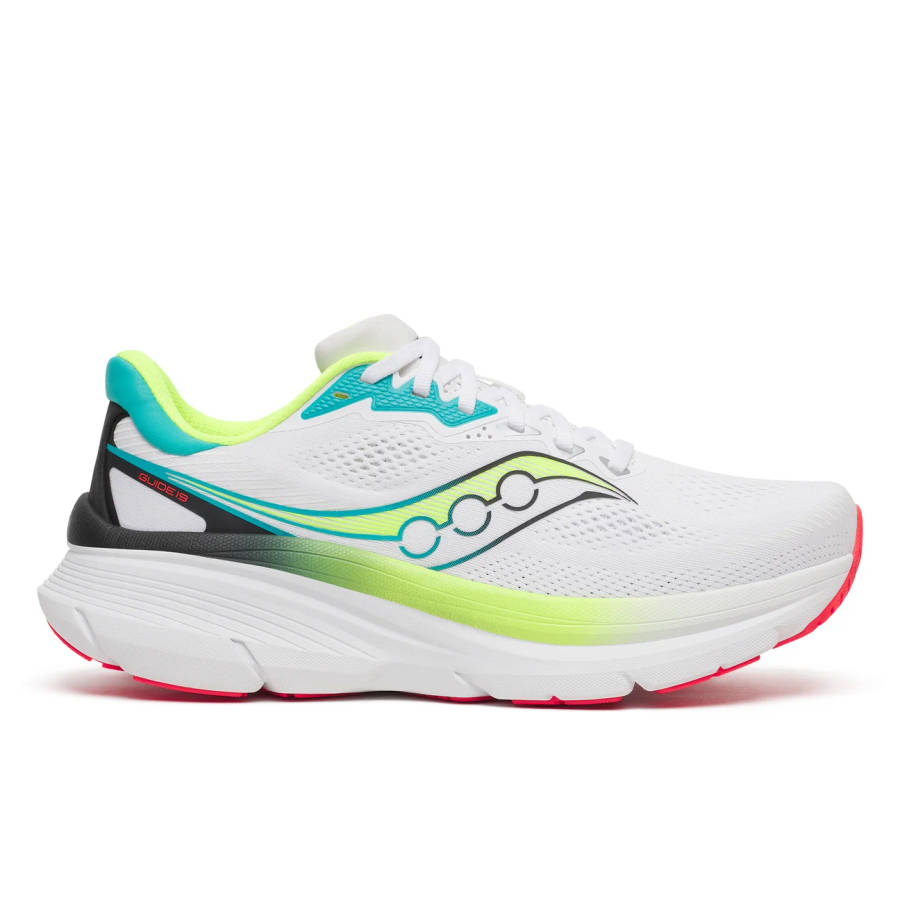
The Saucony Guide 19 is Saucony's dedicated stability daily trainer, built around CenterPath Technology, a softer PWRRUN midsole and a broad, secure platform designed to gently guide your stride rather than force it. In this vibrant Lime Green/White colourway, it's a great option for runners who want mild-to-moderate stability support without a rigid, over-engineered feel. If you need a bit of guidance on your daily miles without a shoe that fights your natural stride the Guide 19 is worth trying.
Quick Technical Specifications
| Category | Stability Daily Trainer |
| Support | Stability (mild-to-moderate, guidance-based) |
| Surface | Road |
| Weight | 252g / 8.9oz (Women's US8, manufacturer stated) |
| Heel Drop | 6mm |
| Stack Height | 35mm heel / 29mm forefoot |
| Midsole | PWRRUN foam (reformulated, softer blend for v19) |
| Upper | Engineered mesh, updated heel collar foam |
| Outsole | Increased rubber coverage for added durability |
| Stability Feature | CenterPath Technology broad-based platform with higher sidewalls |
| Plate | None |
| Colour | Lime Green/White |
| Ride Feel | Soft, broad, guided a smooth roll rather than a firm correction |
| Best Use | Daily training, long runs, recovery, walking |
| Price Category | Mid-range stability trainer |
Product Overview
The Guide has long been Saucony's answer for runners who want a bit of guidance through their stride without stepping into a heavily posted, old-school stability shoe. Recent versions moved away from a traditional medial post and toward CenterPath Technology a design that widens the platform and raises the sidewalls around the midsole rather than inserting a firmer wedge of foam. The result is a shoe that nudges your foot back toward a centred position through the gait cycle, rather than blocking or resisting motion outright.
For version 19, Saucony's main update is underfoot. The PWRRUN midsole has been reformulated to a softer blend, aimed at making the ride feel more plush and less clinical than previous Guide models, which some runners found a little firm and uninspiring. The engineered mesh upper has also been refreshed, with more cushioning through the heel collar and tongue for a comfortable, secure step-in feel. Saucony has increased outsole rubber coverage too, aimed at improving durability over the life of the shoe.
Who benefits from this? Runners with mild-to-moderate overpronation who want support without feeling like the shoe is fighting their natural stride. It also suits runners who've found traditional high-drop, heavily posted stability shoes uncomfortable the Guide 19's 6mm drop and broad platform offer support in a different, more modern way. It is not the shoe for someone who needs strong, aggressive medial control for significant pronation issues that runner should be assessed properly and may need a firmer-posted design instead. We cover this in more detail in our Durban Runner recommendation below.
Technology Explained
CenterPath Technology
What it is: Saucony's guidance-based stability system, built into the midsole and outsole geometry rather than relying on a traditional medial post.
How it works: A wider platform, combined with raised sidewalls around the midsole, gently guides the foot back toward a centred path through the gait cycle. Instead of a firm wedge resisting inward roll, the broad base and structure work together to keep the foot tracking naturally.
Why it matters: Traditional medial posts can feel intrusive or abrupt for some runners, especially those with only mild support needs. A guidance-based system offers a gentler, more forgiving form of stability that many runners find more comfortable over long distances.
Who benefits: Runners with mild-to-moderate overpronation, or those who've found older-style posted stability shoes too rigid or uncomfortable.
Reformulated PWRRUN Foam
What it is: Saucony's PWRRUN cushioning compound, updated for the Guide 19 with a softer blend than previous versions.
How it works: PWRRUN is an EVA-based foam tuned for a balance of cushioning and durability. The softer formulation for v19 is aimed at improving comfort underfoot without sacrificing the compound's reliability over higher mileage.
Why it matters: A softer midsole feel makes the Guide 19 more forgiving on tired legs during long runs, while still holding up over the shoe's lifespan.
Who benefits: Runners who want a plush, comfortable ride on their daily and long-run mileage, rather than a firm, race-oriented feel.
Wide-Base Platform Geometry
What it is: An intentionally broad footprint through the heel, midfoot and forefoot roughly 110mm at the heel, 90mm at the midfoot and 120mm at the forefoot on lab measurement.
How it works: A wider base increases ground contact and creates a larger, more stable platform for the foot to land and push off from, reducing the tendency to roll excessively inward or outward.
Why it matters: This is one of the more "invisible" ways to build stability into a shoe you get a steadier ride without feeling like the shoe is doing something to your foot.
Who benefits: Runners who want stability support that feels natural underfoot, including many first-time stability shoe wearers.
Increased Outsole Rubber Coverage
What it is: An outsole layout with more rubber than previous Guide versions, aimed specifically at durability.
How it works: More rubber across key contact zones reduces the rate of wear in high-friction areas, extending the usable life of the shoe.
Why it matters: Stability shoes are often chosen by runners logging consistent, high weekly mileage durability really matters for this audience.
Who benefits: Runners putting in regular daily kilometres who want their shoe to hold up over the months, not just the first few runs.
Ride Experience
Landing: Soft and forgiving, particularly through the heel, thanks to the reformulated PWRRUN foam.
Transition: Smooth, aided by the Guide's classic rocker geometry that rolls the foot forward through the stride.
Toe Off: Some testers found the forefoot firmer and slightly less flexible than the heel, which can make toe-off feel like it requires a touch more effort, particularly at a lower 6mm drop.
Responsiveness: Moderat...