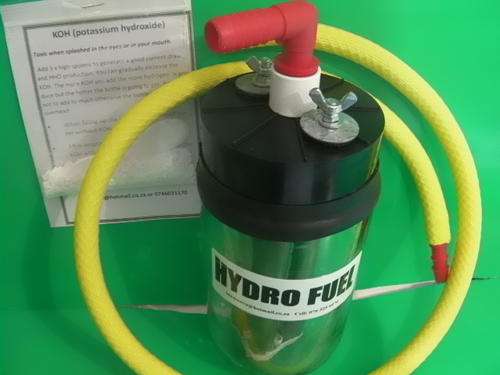
To decrease fuel consumption by 30% or more.
Improve Horsepower and Lower Emissions!
1. What does HHO means?
HHO consists of two parts Hydrogen and one part Oxygen. The addition of the Oxygen molecule makes HHO more combustable than pure Hydrogen.
FACT: Pound for pound HHO is 10x MORE powerful than petrol or diesel fuel!
HHO Gas packs incredible power, increasing horsepower and overall performance while keeping your engine running clean and cool, as well as lowering exhaust gas emissions. This technology has already been tested and proven to work by thousands and thousands of people.
2. How much fuel efficiency will I get?
Most users have economies from 20 to 50% in fuel consumption. There are cases of higher results.
3. What advantage does HHO gas present when used as an internal combustion engine supplemental fuel ?
There are many advantages. HHO gas reduces fuel consumption by increasing the octane level and forcing the base fuel to burn more completely and efficiently. Higher octane result in increased horsepower. Higher octane, more horsepower and efficient base fuel ignition equal more km per liter. HHO fuel actually helps to further clean carbon deposits inside the engine. HHO exhaust emissions are pure water. So, you save fuel, save money and save the environment.
FACT: Over 60% of the gasoline that you buy is wasted through fumes, vibration, evaporation and unburned fuel. Just run your finger around the inside edge of your exhaust pipe. That sticky black smudge is wasted, unburnt fuel.... and your wasted money! Once you add HHO to the equation, you change the way your engine processes fuel and increase its potential to use EVERY DROP of gasoline that you pay for. By using HHO gas you clean out your engine every time you drive. HHO burns quickly and powerfully, breaking down existing carbon deposits left by unburnt fuel while protecting your engine from future carbon build-up.
5. Can this system improve my performance?
Yes, the injection of HHO into your internal combustion engine will assist in cleaning the internal parts as the engine runs. It will increase the torque and horsepower and reduce the hydrocarbon pollutants currently being released into the air through your exhaust. Hydrogen burns faster and cleaner than gas or diesel within your engine. This makes your vehicle run smoother, longer, cooler, and more efficiently than ever before.
Easy to install
Full instructions emailed to you.
You only need 2 pieces of electrical wiring and a fuse.
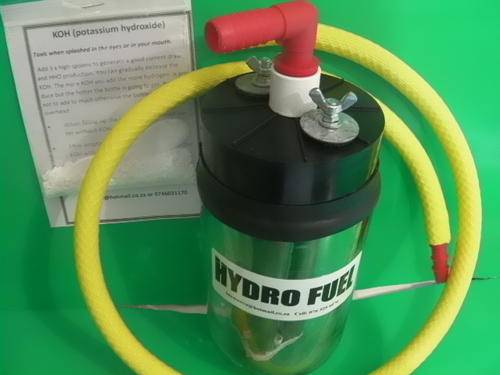
I supply the connecting hose and electrolite to put in the water.
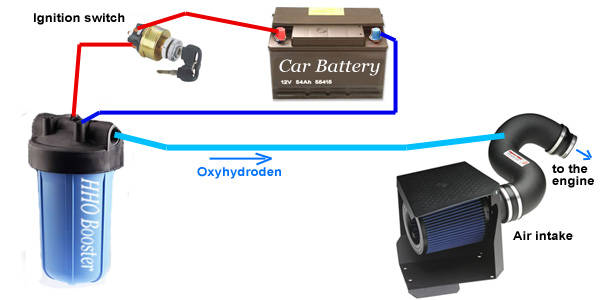
For optimum results: Connect 2 or more fuel cells.Dubble your hydrogen and lower your volts and heat production.
Scientists have proven that HHO does it best
A recent scientific paper titled “Effect of H2/O2 addition in increasing the thermal efficiency of a Diesel engine” has proven it by exact numbers. This scientific publication was first published in 2008 by Bari Saiful and Mohammad Esmaeil, from the Sustainable Energy Centre, School of Advanced Manufacturing and Mechanical Engineering, University of South Australia (Mawson Lakes, Australia).
Quote: “Using hydrogen as an additive to enhance the conventional Diesel engine performance has been investigated by several researchers and the outcomes are very promising. However, the problems associated with the production and storage of pure hydrogen currently limits the application of pure hydrogen in Diesel engine operation. On-board hydrogen–oxygen generator, which produces H2/O2 mixture through electrolysis of water, has significant potential to overcome these problems.
The Australian scientists used a fuel-injected, 4-liter Diesel engine. Using HHO produced by electrolysis of water, they received an average fuel savings of over 15%, while decreasing the emissions of CO2, CO and HC. Observe sample graphs from this paper (courtesy of South Australia University):