
| Main centres: | 1-3 business days |
| Regional areas: | 3-4 business days |
| Remote areas: | 3-5 business days |
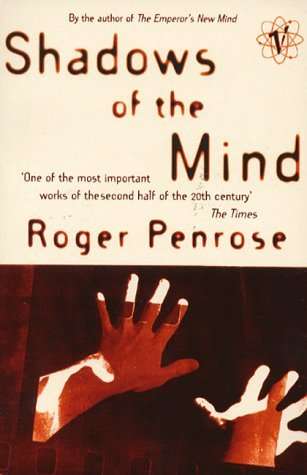
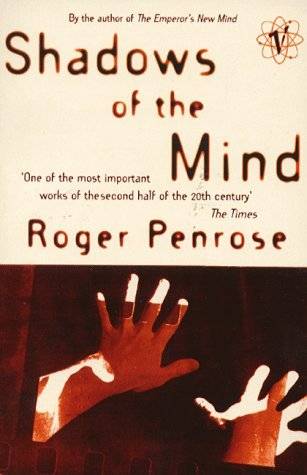
Published by OXFORD UNIVERSITY PRESS, 1995, softcover, illustrated index, 457 pages, condition: new.
The argument is simple. There are mathematical problems that can't be solved using algorithms - non-computable problems. If you device an algorithm to solve that kind of problems, and let a computer run the algorithm, it would never stop. Yet the human mathematician is able to solve that kind of problems. Computational neuroscience (and Artificial Intelligence) treats the brain as a computer: either there is a neuronal signal or not, very much similar to the 0 and 1 scheme. But that algorithmic representation can't be truly faithful to what's really going on in the mathematician's brain. There must be a non-computable ingredient.
Penrose argues then, that there's a deeper level of information processing in the brain, deeper than neural networks. Microtubules is the best candidate for that. Think of a unicellular organism, like an amoeba. How does it know where to go and what to do? It has no nervous system, not even a single neuron. Yet it does what it does, by the means of these cellular automata. One more thing: it appears that things at that molecular level behave according to the strange laws of quantum mechanics, providing the non-computable ingredient.
This is an extraordinary approach to the problem of consciousness, and Penrose is a humble man (although in one of his interviews he pointed out to the interviewer that he should be called "Sir" Roger Penrose!) who doesn't claim to have solved the mystery of consciousness. He clearly states that the argument is strong at least for the quality of understanding. And that other qualities of consciousness like feeling, attention, imagination can't be simply explained by algorithms (only), or be regarded as phenomena emerging out of complexity (the cerebellum is as complex as the cerebrum yet it's totally automated and unconscious).
One of the most important worksof the twentieth century The Times
Shadows of the Mind is a profound exploration of what modern physics has to tell us about the human mind.
In this illuminating book Penrose provides powerful arguments to support his conclusion that there is something in the conscious activity of the brain that transcends computation something that cant be explained by present-day science.