| Main centres: | 1-3 business days |
| Regional areas: | 3-4 business days |
| Remote areas: | 3-5 business days |
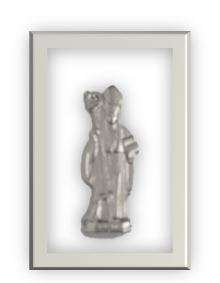
St Patrick 3cm Pocket / Handbag Statue
3cm tall - perfect for carrying with you.
Legends about Patrick abound; but truth is best served by our seeing
two solid qualities in him: He was humble and he was courageous. The
determination to accept suffering and success with equal indifference
guided the life of God's instrument for winning most of Ireland for
Christ.
Details of his life are uncertain. Current research places his dates
of birth and death a little later than earlier accounts. Patrick may
have been born in Dunbarton, Scotland, Cumberland, England, or in
northern Wales. He called himself both a Roman and a Briton. At 16, he
and a large number of his father's slaves and vassals were captured by
Irish raiders and sold as slaves in Ireland. Forced to work as a
shepherd, he suffered greatly from hunger and cold.
After six years Patrick escaped, probably to France, and later
returned to Britain at the age of 22. His captivity had meant spiritual
conversion. He may have studied at Lerins, off the French coast; he
spent years at Auxerre, France, and was consecrated bishop at the age of
43. His great desire was to proclaim the good news to the Irish.
In a dream vision it seemed "all the children of Ireland from their
mothers' wombs were stretching out their hands" to him. He understood
the vision to be a call to do mission work in pagan Ireland. Despite
opposition from those who felt his education had been defective, he was
sent to carry out the task. He went to the west and northwhere the
faith had never been preachedobtained the protection of local kings,
and made numerous converts.
Because of the island's pagan background, Patrick was emphatic in
encouraging widows to remain chaste and young women to consecrate their
virginity to Christ. He ordained many priests, divided the country into
dioceses, held Church councils, founded several monasteries and
continually urged his people to greater holiness in Christ.
He suffered much opposition from pagan druids and was criticized in
both England and Ireland for the way he conducted his mission. In a
relatively short time, the island had experienced deeply the Christian
spirit, and was prepared to send out missionaries whose efforts were
greatly responsible for Christianizing Europe.
Patrick was a man of action, with little inclination toward learning.
He had a rock-like belief in his vocation, in the cause he had
espoused. One of the few certainly authentic writings is his
Confessio, above all an act of homage to God for having called Patrick, unworthy sinner, to the apostolate.
There is hope rather than irony in the fact that his burial place is
said to be in County Down in Northern Ireland, long the scene of strife
and violence.
What distinguishes Patrick is the durability of his efforts. When one
considers the state of Ireland when he began his mission work, the vast
extent of his labors, and how the seeds he planted continued to grow
and flourish, one can only admire the kind of man Patrick must have
been. The holiness of a person is known only by the fruits of his or her
work.
Engineers
Ireland
Nigeria