| Main centres: | 1-3 business days |
| Regional areas: | 3-4 business days |
| Remote areas: | 3-5 business days |
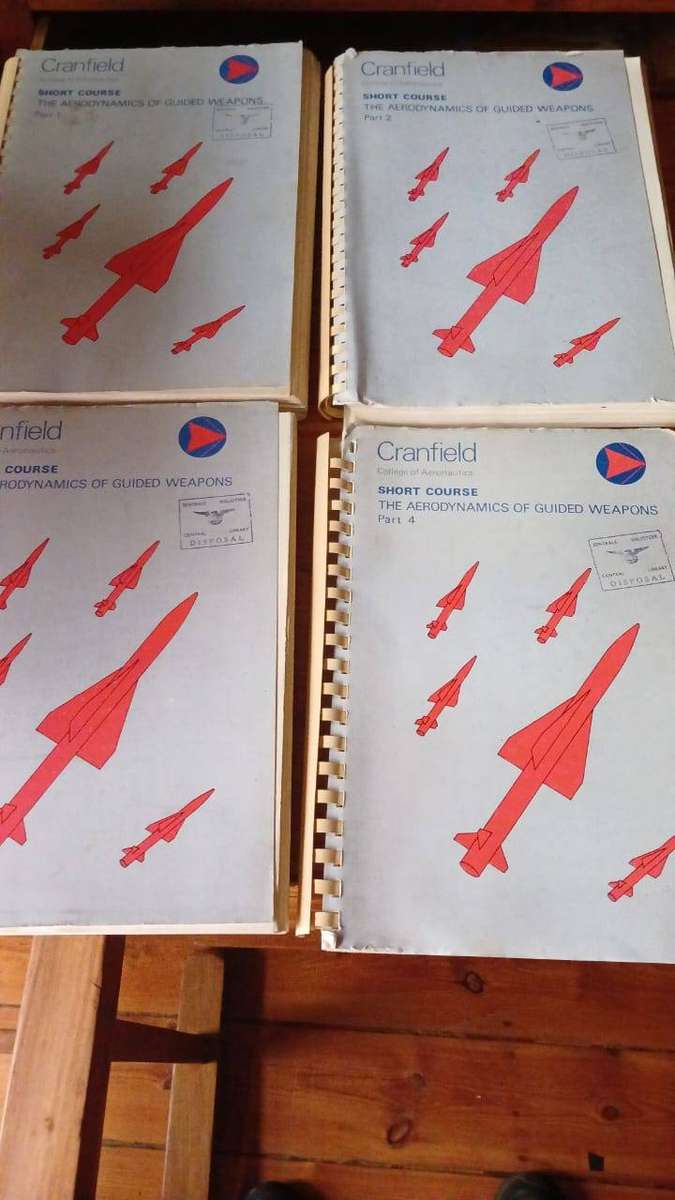
The Aerodynamics of Guided Weapons, 4 volumes, Cranfield College of Aeronautics, short course, large format, no date, illustrated, spiral bound, condition: very good.
Introduction to the missile and the system; constituent parts of the missile and how they integrate into the complete system; the threat and how it can be countered; overview of subsystem operating principles, requirements and trade-offs.
General principles of reaction thrust and jet propulsion; overview of propulsion system selection criteria; rocket principles of operation; propulsion performance parameter definitions; solid propellant design considerations; air-breather (turbojet, turbofan, ramjet and scramjet) characteristics; component design; propellants; flight mechanics.
Airframe materials and structures; subsonic, transonic, supersonic and hypersonic flows; factors affecting aerodynamic lift and drag and means of enhancing lift/drag ratios.
Polar, Cartesian and roll control; aerodynamic and thrust vector control; actuation systems; instrumentation; accelerometers; rate and position gyroscopes; acceleration and velocity control; roll rate and position, lateral acceleration and altitude autopilots.
The need for guidance; types of trajectory; system characteristics and classification; command, homing and navigational guidance principles and coverage diagrams.
Basic principles of radar systems; antenna beam widths and patterns; antenna sizing; radar range equation; waveforms; range resolution; surveillance requirements; clutter; target acquisition and classification; modes of radar operation; real beam scanning; Doppler and velocity; micro-Doppler; imaging radar systems; synthetic aperture radar; example radar systems.
Attenuation versus frequency; MMW pros and cons; beamwidth versus frequency; antenna considerations; range resolution; Doppler frequency; schematic diagram; range limitations; transmitter power limits; weather attenuation; applications; target recognition; range profiling; waveforms; GW examples.
Homing systems; spin-scan and con-scan techniques; proportional navigation method; pulse modulation without reticle; pseudo imaging systems; pulse width discrimination; imaging and staring systems; advanced seeker examples; flares; counter-countermeasures; jammers; missile approach warners; DIRCM/ATIRCM; retro-reflection.
EM spectrum; photon energy, emissions and effects; stimulated emissions and lasers; amplification issues; population inversion; excitation methods; laser materials; pulsed and continuous wave methods; cavities; level laser action; energy levels; Gaussian beam and divergence; laser mode and techniques; laser types; uses (rangefinders, designators, pointers, beam riding, fusing, Directed Energy Weapons).
Loads analysis; stress and structural analysis principles; materials selection considerations; aeroelasticity effects.
Internal and external carriage, store separation and jettison considerations, aerodynamic changes with missile carriage, weapon bay flow types, missile modifications for internal and external carriage, loading and unloading, data transfer and fidelity requirements.Factors affecting aircraft airworthiness.