

| Main centres: | 1-3 business days |
| Regional areas: | 3-4 business days |
| Remote areas: | 3-5 business days |
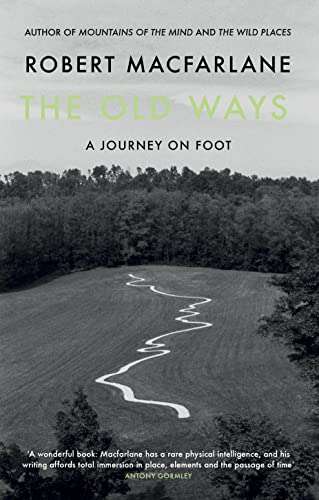
Hamish Hamilton, 2012, hardcover, illustrated, index, 433 pages, condition: new.
This one really hit the sweet spot for me. It gets you tuned into walking journeys all over the U.K. with side trips in Spain, Palestine, and Tibet. Lyrical presentations of the authors sensory experiences with the geography and the flora and fauna are harnessed as a gateway to history of the particular paths he took and the inspired outlooks of people who have thought deeply about the affinity of the human mind and civilization to walking in general and connectedness to the land.
I have long been fascinated by how people understand themselves using landscape, by the topographies of self we carry within us and by the maps we make with which to navigate these interior terrains. We think in metaphors drawn from place and sometimes those metaphors do not only adorn our thought, but actively produce it.
MacFarlane finds insight in how much human language is infused with words for travel paths and their purpose. For example, an Aboriginal tribe in western Canada has the same word for knowledge and footprint, and the Tibetan word shul carries the senses of path forward, footprint, and awareness of past events. English is particularly rich in pregnant words for pathways:
Pilgrim paths, green roads, drove roads, corpse roads, trods, leys, dykes, drongs, sarns, snicketssay the names of paths out loud and at speed and they become a poem or riteholloways, bostles, shuts, driftways, lichways, ridings, halterpaths, cartways, carneys, causeways, herepaths.
MacFarlane reckons he was walked 5 or 6 thousand miles on his foot journeys. Some of his predecessors were even more obsessed with this mode of being. Wordsworth is believed to have trekked over 100,000 miles. Wittgenstein literally couldnt think properly without walking. His favorite walking aficionados are the British poet and essayist Edward Thomas, who worked early in the 20th century led him and inspired Robert Frost to write his most famous poem, Two Roads, and Nan Shepherd, who wrote philosophical meditations in the 1970s on her experience with the high rocky trails of the Scottish Cairngorns. As McFarlane visits the ancient pathways they explored through the British geology of chalk and granite, he revisits their ideas on the conflation time and space:
Paths and their markers have long worked on me like lures: drawing my sight up and on and over. The eye is enticed by a path, and the minds eye also. The imagination cannot help but pursue a line in the landonwards in space but also backwards in time to the histories of a route and its previous followers. As I walk paths I often wonder about their origins, the impulses that have led to their creation, the records they yield of customary journeys, and the secrets they keep of adventures, meetings and departures.
The concept that the earliest stories are told not in print but footprint is brought home by a walk on a beach where erosion of each tide uncovers prehistoric footprints preserved in the mud. He walks in the path of a hunter and spies prints left by playing children. He makes a wonderful digression on the anatomy of feet:
The whole foot is a document of motion, inscribed by repeated action. Babiesfrom those first foetal footfalls, the kneading of the sole against womb-wall, turning themselves like astronauts in black spacehave already creased their soles by the time they emerge into the world.
McFarlane finds further roots for his mode of thinking in the romanticism of George Burrow in the mid-19th century and early environmentalism of John Muir toward the end of the century. But as with classic travel books, he takes delight in the inspiration of the colorful, living people he meets on his journeys. His story is enriched as he expands his line of thinking to seaways and riverways. A trip in a small boat in the Outer Hebrides to a remote bird nesting island long targeted for an annual harvest leads to ruminations on how human use of known pathways over the water in prehistoric times made these apparently isolated communities by the sea more connected culturally with comparable seafaring peoples in the Baltic and Mediterranean countries than with communities of inland U.K. at the time--the sea as gateway. A visit to ancient pilgrim paths in Spain and Tibet rounds out the wonderful journeys in this book.
This book brought me exquisite pleasures and permanently shaped how I look at the world. I place it on my spiritual shelf with treasured travel books such as Mattiessens The Snow Leopard, Cotwins In Patagonia, and Brysons A Walk in the Woods. The inscription to the volume still resonates:
it is about a road which begins miles before I could come on its traces and ends miles beyond where I had to stop. Edward Thomas (1913)