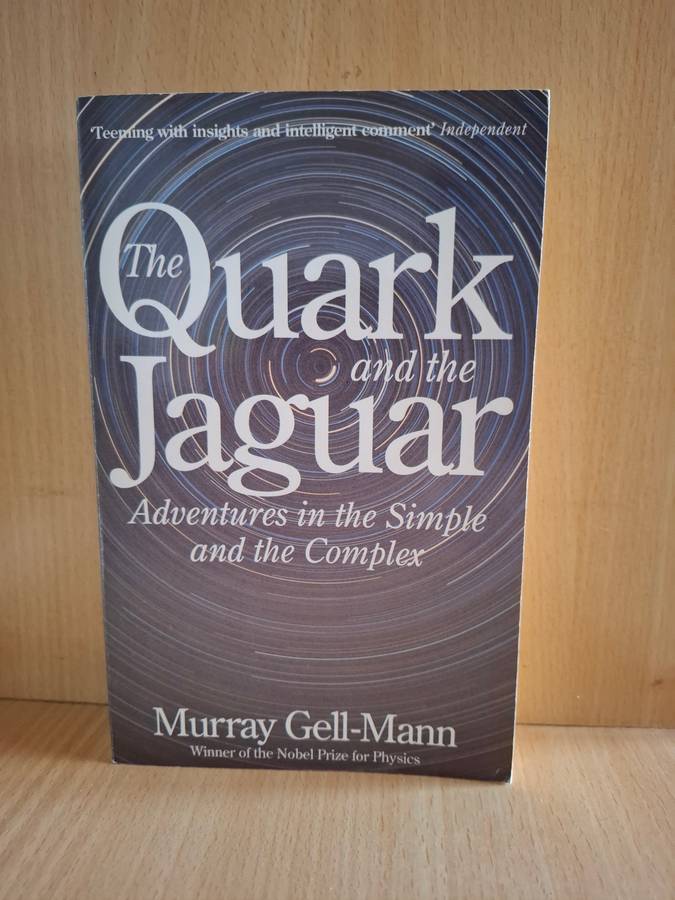
The Quark and the Jaguar, Adventures in the Simple and the Complex by Murray Gell-Mann
Check my rate
View locations
| Main centres: | 1-3 business days |
| Regional areas: | 3-4 business days |
| Remote areas: | 3-5 business days |
| Main centres: | 1-3 business days |
| Regional areas: | 3-4 business days |
| Remote areas: | 3-5 business days |
Published by Abacus, 1995, index, 390 pages, condition: new.
From one of the architects of the new science of simplicity and complexity comes an explanation of the connections between nature at its most basic level and natural selection, archaeology, linguistics, child development, computers, and other complex adaptive systems. Nobel laureate Murray Gell-Mann offers a uniquely personal and unifying vision of the relationship between the fundamental laws of physics and the complexity and diversity of the natural world.
The Quark and the Jaguar is about learning, albeit three distinct types of learning: (1) humans learning about our world and universe, (2) our world and universe learning what laws, rules, and configurations can function in the long run, and (3) computers designed by humans learning from data. Learning type (1) is obviously what Gell-Mann has done for most of his lifetime as a theoretical physicist and general applied scientist. Learning type (2) is what Gell-Mann has discovered in his lifetime as a scientist: that every system in our universe---from quantum physics to genetic evolution to economics---is an example or result of that system having tried many possibilities and settling on the few that work. The theory and literature on learning type (3) provide the necessary framework and terminology with which we can discuss learning types (1) and (2), since, in essence, all three types are one and the same, but with different physical objects at the center. Gell-Mann calls these objects "complex adaptive systems" and demonstrates how a machine learning algorithm can be very much like the process of evolution, the training of a dog, or even the settling of our cosmos into the physical laws we know and accept today.