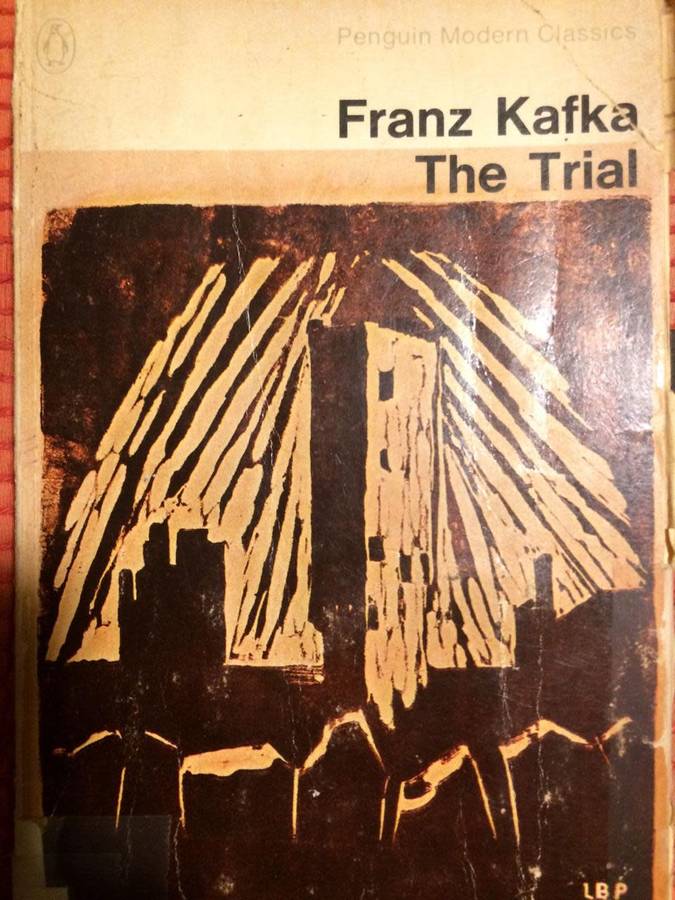
About the book:
A man is arrested one morning without being told what he has done, and spends the rest of the novel attempting to navigate a legal system that refuses to explain itself.
Published posthumously in 1925, against Kafka's wishes for all his unpublished works to be burnt by Max Brod.
The defining literary expression of institutional absurdity and the experience of powerlessness before systems that operate by their own opaque logic.
Condition:
Good secondhand condition.
Inscription on inner front cover.
Browse our other listings:
https://www.bobshop.co.za/seller/5375758/Orphan_Books
About the author:
Franz Kafka (1883 to 1924)
Franz Kafka was born in Prague in 1883, into a German-speaking Jewish family in the Austro-Hungarian Empire, and spent much of his life negotiating the shadow of his father Hermann, a self-made merchant whose contempt for his son's ambitions Kafka never stopped writing around. He studied law at the German University in Prague and spent his adult life at an insurance institute, writing at night. Family pressure, a Jewish identity under constant low-grade threat, and a body that eventually turned on him tuberculosis, diagnosed in 1917 gave his fiction its particular grain of dread.
He published almost nothing of consequence in his lifetime: a handful of stories, three novels left unfinished. The reputation came after, and came enormous. What he'd developed was a style precise to the point of hallucination flat, bureaucratic sentences describing the absurd as though it were merely Tuesday. Dread, in Kafka, doesn't announce itself; it accumulates.
He read Dostoevsky, Dickens, Flaubert, and Yiddish theater closely, and turned that reading, along with his own alienation, into something that reshaped the century after him. Existentialism and absurdism both run through him; Camus, Sartre, and Beckett are unthinkable without him, and his fingerprints are all over Borges and García Márquez's sense of what a sentence is allowed to do to reality. The word "Kafkaesque" outgrew him entirely and became a way of describing the world.
The obsessions repeat across the work without ever wearing thin: guilt without a clear crime, authority that has no face, the private self flattened by systems it can't see the edges of. The Metamorphosis, The Trial, The Castle, The Judgment, Amerika the through-line is a man waking up to find the rules have changed and no one will tell him what they are.
He died of tuberculosis in 1924, at forty. His friend Max Brod defied his instructions to burn the manuscripts and published them instead, which is the only reason any of this exists to be read. Kafka's influence on what followed is hard to overstate no other writer has made dread feel this intelligent, or this quietly, terribly funny.