| Main centres: | 1-3 business days |
| Regional areas: | 3-4 business days |
| Remote areas: | 3-5 business days |
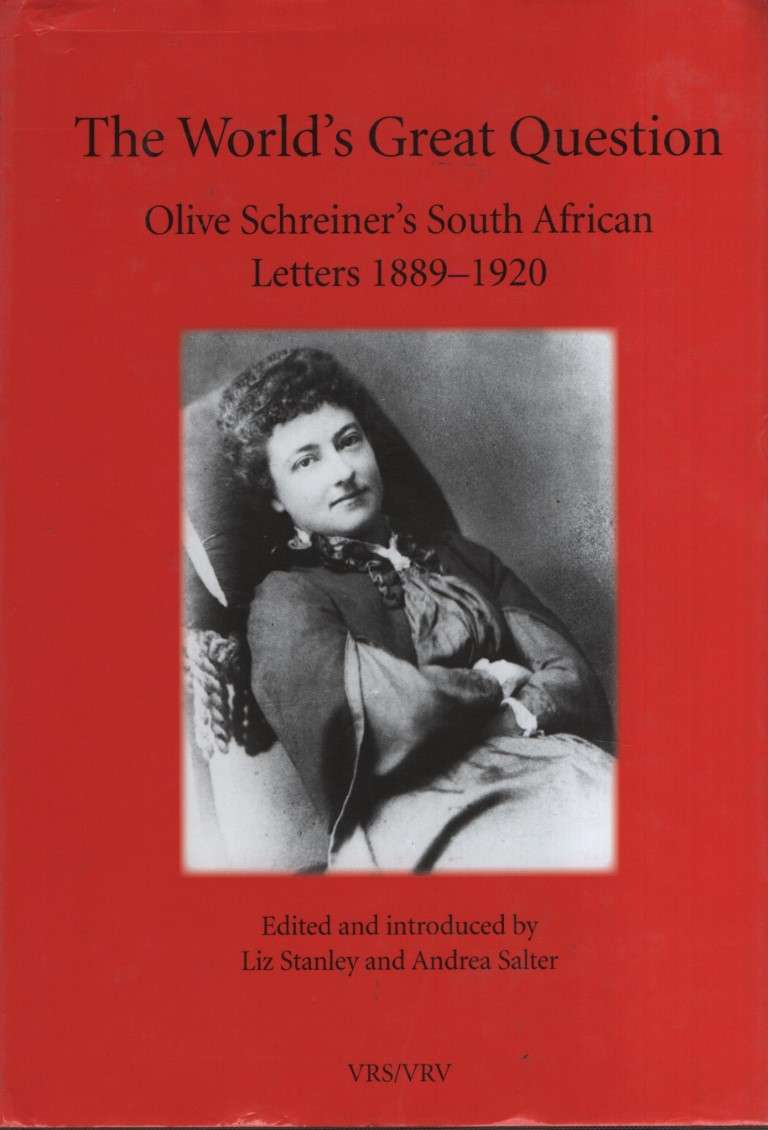
The Worlds Great Question features over 300 of Olive Schreiners key letters on South African people, politics, and its racial order. They are often prophetic and can still send shivers down the spine. Immensely readable and insightful, her South African letters:
Olive Schreiner was born in 1855 at a mission station Wittenbergen in todays Herschel District of the Eastern Cape near the border of the Free State and Lesotho. Her farther Gottlob, employed by the London Missionary Society, arrived in South Africa with his wife in 1838 and all their twelve children were born at the mission station. They both imposed a strict religous evangelicalism on their children. Olive, when twelve years of age, was sent to stay with her elder brother in Cradock where he was the headmaster of a school where she would have finished her schooling.
Schreiner sought financial independence through becoming a governess for a succession of mainly Boer farming families in the Cradock area. It was through these experiences, she later commented, that she changed her ideas about race and ethnicity regarding Boers and black people.
She left South Africa for Britain in late 1881 to pursue nursing training but it ended as a result of severe chest infections and asthma attacks. Her book The Story of an African Farm was published in London when she was but twenty-eight years old in 1883 and it immediately received many laudatory reviews and considerable publicity making her famous and financially independent. During her stay in England she became involved in political activities, joining socialist-inclined organisations and more particularly the rights of women.
She returned to South Africa in 1889 and due to her poor health she was forced to pass much of her life in isolated locations of her 23 years in the country after her return, eighteen were spent on farms or in remote villages like Matjiesfontein, Hanover, and De Aar. Letters were central to her interaction with others. She became involved in South African politics and met Rhodes, for a short time admiring him but soon changed her mind, from attraction and support to open opposition. Bitter disagreements erupted within the Schreiner family about British imperialism in South Africa which continued through the South African War of 1899-1902.