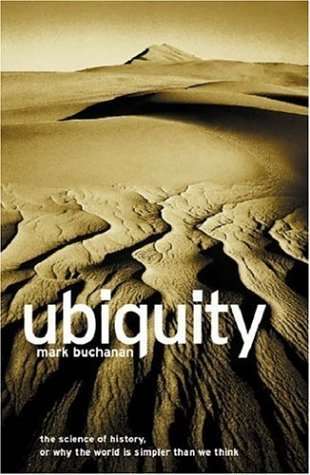
Phoenix Books, 2002, softcover, illustrated, index, 230 pages, condition: new.
Why do catastrophes happen? What sets off earthquakes, for example? What about mass extinctions of species? The outbreak of major wars? Massive traffic jams that seem to appear out of nowhere? Why does the stock market periodically suffer dramatic crashes? Why do some forest fires become superheated infernos that rage totally out of control?
So much better than Black Swan. The topic is similar to a degree although without personal hubris or any obsession to limit the discussion to financial markets or any vendetta against another equally useful Gaussian function as was the case with the other much more popular book.
Physics all around--also watching the three part Nova series with youngest son about the fabric of the cosmos.
I'm most intrigued by Buchanan's discussion of instability, that many systems build up pressure of some sort and exist on what he calls the knife of instability. This critical state lends itself to occasional upheavals (an earthquake, massive extinctions, a war) with one small shift in the system. That is big events do not have big causes--how marvelously counterintuitive. His overriding metaphor is a sand pile which, surprisingly, physicists have spent much time playing in. And even more surprisingly, they have found that there is no "typical" size of an avalanche in a sand pile--sometimes only a few grains of sand, sometimes hundreds, sometimes thousands. The avalanches appear to be completely random.
Yet if this is the case then it is nearly impossible, then, to predict these upheavals. Of course this is akin to chaos theory but he moves beyond early chaos theory to describe power laws which describe the "patterns" of upheavability. These power laws do not allow us to predict one particular event; instead they demonstrate that across many systems both geological and biological there is a correlation between the number of small events (e.g. small earthquakes) and the number of large upheavals (e.g. massive earthquakes).
So while these power laws do not have much practical value at this point, they do, as physics often does, point to an underlying system which is not random yet is also not predictable. Finally he uses these theories to (which will undoubtedly disturb some) history where he argues against the great person or genius theories of history. Of course, as he admits, many historians have already questioned this analysis of history. What Buchanan adds is that nonequalibrium physics is the proper field to describe what will happen--not just in sand piles and earthquakes but in the most complex of human systems.