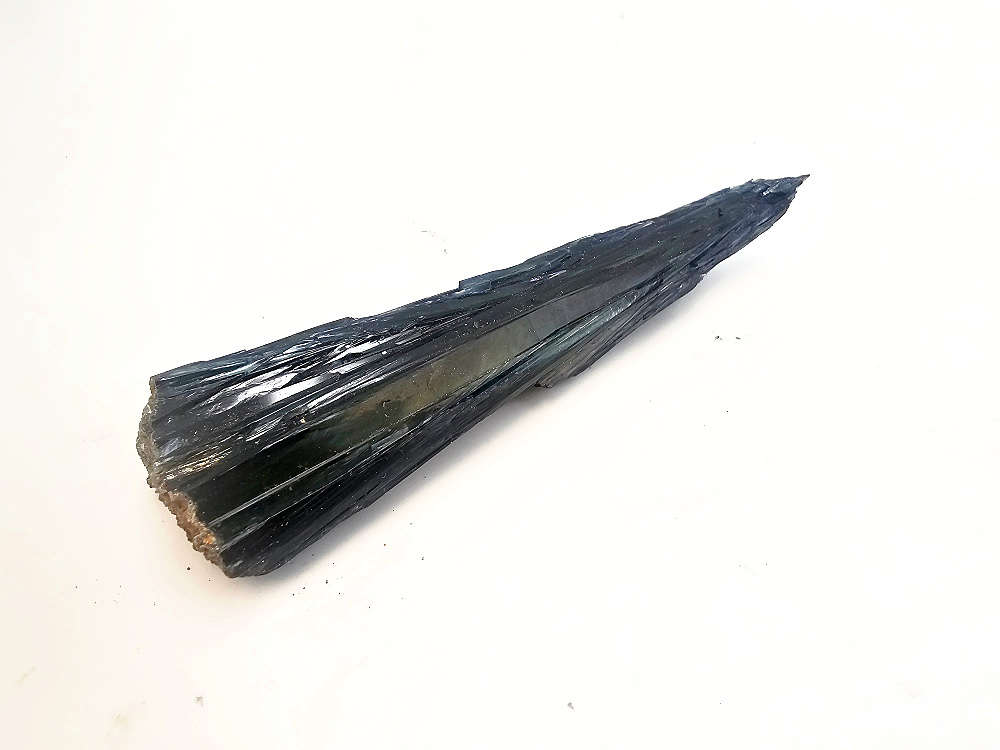
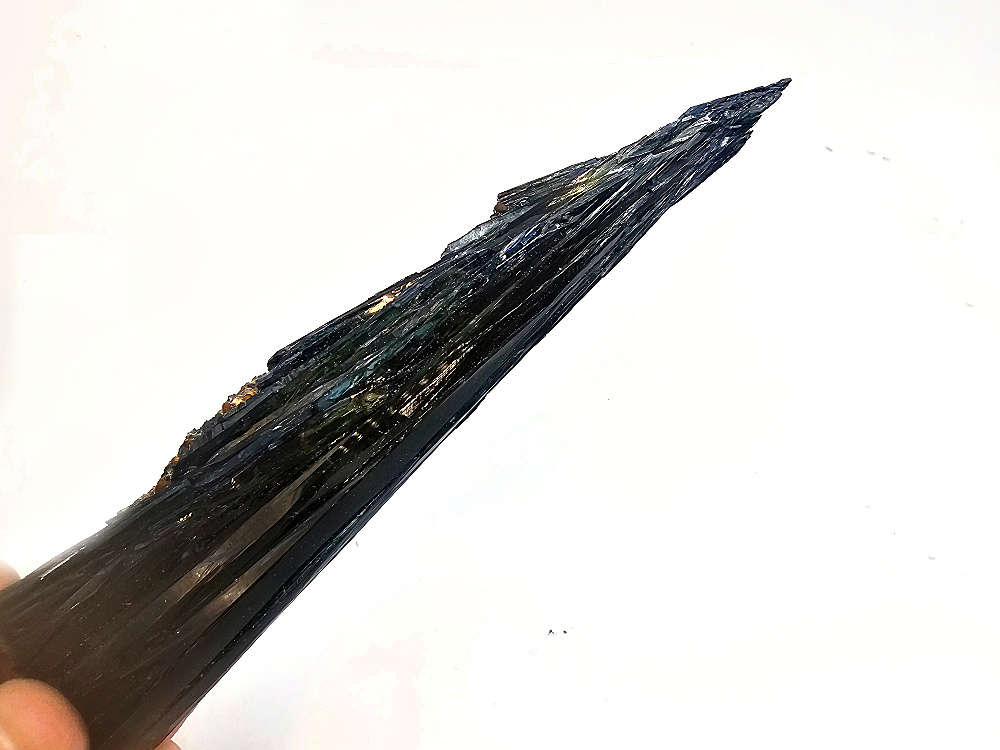
Vivianite Blade D Natural Blue-Green Mineral Specimen 66g
This Vivianite blade is a wonderfully unusual natural mineral specimen weighing approximately 66g and measuring around 12.5 x 3cm. Its long, sharply pointed shape immediately gives it character, but there is even more going on when you turn it over: one side carries a little iron oxide matrix, while the other reveals lots of blue and green glimmers as the mineral catches the light.
Vivianite is one of those minerals whose story is every bit as fascinating as its appearance. It can change colour after formation, is notably sensitive to light and, under very particular environmental conditions, has even been documented forming on buried human and animal remains.
So this is definitely not your average pretty blue-green crystal.
Explore more examples of this unusual mineral in our Vivianite collection.
Product Details
- Mineral: Natural Vivianite
- Form: Rough blade specimen
- Size: Approx. 12.5 x 3cm
- Weight: Approx. 66g
- Colour: Blue and green glimmers
- Small amount of iron oxide matrix on one side
- Long, pointed and sharp natural shape
- Individual natural mineral specimen
- Includes a crystal meaning card
What Is Vivianite?
Vivianite is a hydrated iron phosphate mineral with the chemical formula Fe(PO)·8HO.
It can form in wet, oxygen-poor environments where iron, phosphate and water come together under suitable conditions. These environments can include sediments, bogs and areas containing decomposing organic material.
Vivianite can form elongated, prismatic and bladed crystals, making the long, narrow character of this specimen particularly fitting.
Its colour is another part of what makes it so collectable. Vivianite can initially be very pale, with oxidation contributing to the development of increasingly noticeable green, blue-green and blue colouring.
See more natural mineral specimens in our Selected Crystals Rough collection.
Did You Know? Vivianite Can Form on Human Remains
This is where Vivianite becomes seriously interesting.
Under the right burial conditions, Vivianite can actually form on and around decomposing bones and other organic remains.
As organic material decomposes, phosphate can become available in the surrounding environment. Combine that with iron, moisture and low-oxygen conditions, and the chemistry can allow Vivianite to form.
This phenomenon has been documented on archaeological remains and in forensic investigations, where blue-green Vivianite has been found associated with human bones.
One particularly fascinating case involved centuries-old human remains recovered from Lake Brienz in Switzerland. Blue Vivianite deposits had developed on the remains an example of how the chemistry surrounding a body after burial can eventually produce an actual mineral.
Vivianite doesn't require a dead body to form. It occurs in other phosphate-rich, waterlogged geological environments too. But its association with decomposing remains is completely genuine and gives the mineral one of the stranger backstories you'll encounter in a crystal collection.
Rather appropriately, Vivianite has even attracted interest in archaeology and forensic science because its presence can provide clues about the chemical environment surrounding buried remains.
Not bad for a mineral that looks like it simply decided to be blue-green and pretty.
Did You Know? Vivianite Can Change Colour
Vivianite has another remarkable characteristic: its colour can change after it forms.
Fresh Vivianite may initially be pale or almost colourless. As oxidation occurs, the mineral can develop increasingly noticeable green, blue-green and blue tones before becoming considerably darker.
Light exposure can contribute to further alteration and darkening, which means the changing colour isn't merely an interesting mineralogical fact it's something collectors need to consider when deciding where to display Vivianite.
The blue and green glimmers on this specimen are part of its appeal, but it shouldn't spend its life baking on a sunny windowsill.
A protected position away from prolonged strong light is much better for long-term display.
Blue & Green Glimmers with Iron Oxide Matrix
The two sides of this piece offer quite different views.
One side has some natural iron oxide matrix, while the other displays lots of blue and green glimmers. Turn it slowly under gentle indirect light and different areas may become more noticeable as the viewing angle changes.
The presence of iron oxide is particularly fitting because iron isn't just associated material here iron is fundamental to Vivianite's own chemistry.
Matrix can also make a rough mineral specimen more interesting. Instead of looking like an isolated, perfectly prepared piece, some of the surrounding geological character remains attached.
You can browse an even wider variety of natural and polished minerals in our Crystals collection.
Vivianite Meaning & Traditional Associations
Within contemporary crystal traditions, Vivianite is commonly associated with renewal, compassion, emotional openness and personal growth.
Common associations include:
- Renewal
- Compassion
- Growth
- Emotional openness
- Reflection
- Hope
- Moving forward
- Heart-centred intentions
- Inner exploration
Its green and blue-green colouring has also contributed to modern associations with emotional expression and communication.
Vivianite is most commonly connected with the heart chakra, while its blue-green tones are sometimes associated with the throat chakra.
There is something rather fitting about a mineral associated symbolically with renewal having such an extraordinary natural relationship with decomposition, transformation and the recycling of materials within the environment.
A Beautiful Blade But Watch That Point
At approximately 12.5cm long and only around 3cm across, this specimen has a distinctly elongated blade shape with a genuinely sharp, pointed end.
It looks fantastic, but this is a mineral specimen rather than a polished crystal intended for constant handling.
Support the main body when picking it up instead of lifting it by the tip. Display it somewhere stable where it won't easily be knocked from a shelf, and avoid storing it loose amongst heavier minerals.
Beca...