

| Main centres: | 1-3 business days |
| Regional areas: | 3-4 business days |
| Remote areas: | 3-5 business days |
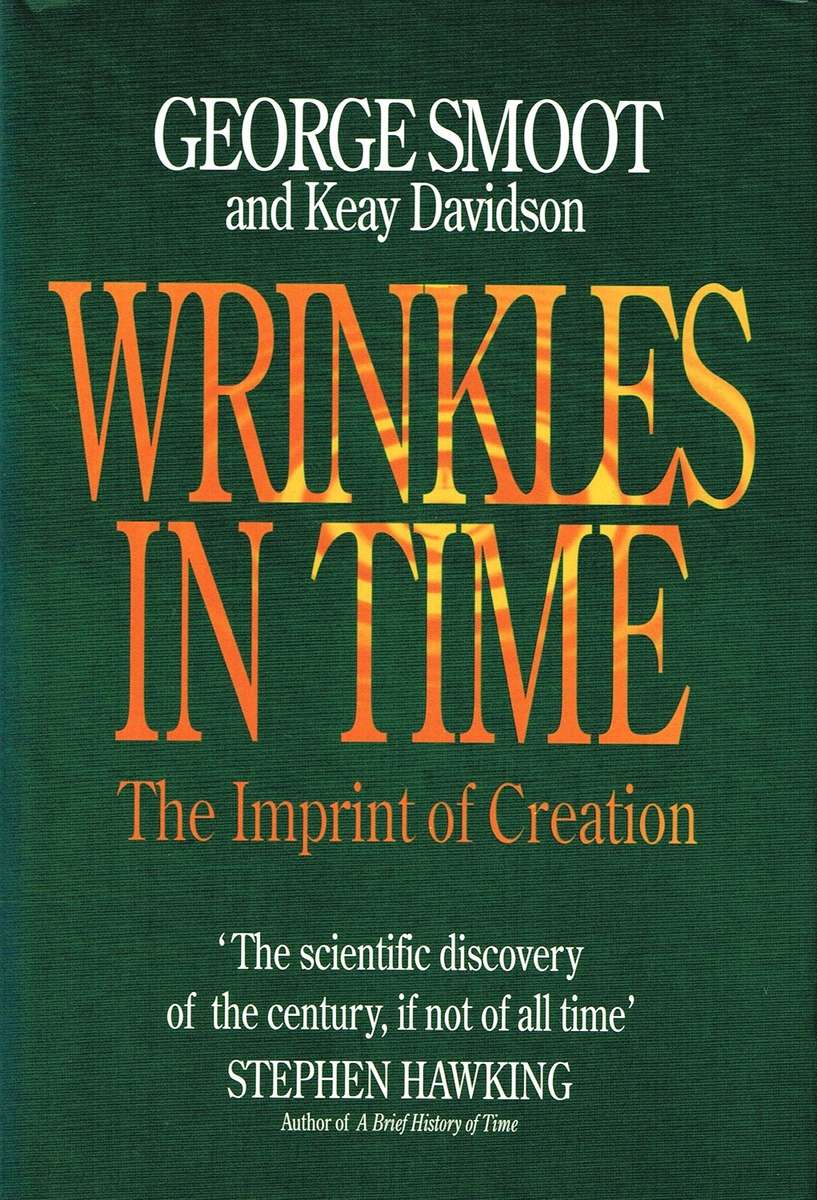
Published by Little, Brown, 1993, hardcover, index, illustrated, 315 pages, condition: new..
In April 1992 astrophysicist George Smoot announced how he and his team of scientists had found "ripples in the fabric of space-time" that were made in the first trillionth of a second after the cataclysmic moment of creation. Their discovery of the ripples was central to the Big Bang Theory, which explains why the universe did not remain uniformly smooth, but became the "lumpy" universe of today, filled with stars, planets and galaxies. By the summer of 1991 Smoot's Cosmic Background Explorer (COBE) satellite had discovered the tiny ripples that had been put there by the primeval explosion process. Shaped by the force of gravity, the smaller of these ripples have grown into galaxies and the great voids in space. This is Smoot's account of his discovery of the driving mechanism of the universe, a discovery which will stimulate debate for years to come.
Smoot started doing cosmology, though he didn't immediately get involved with the CMBR. His first project was an attempt to detect antimatter atoms in cosmic rays, which at the time was another hot topic: some people thought there was a lot of antimatter out there just waiting to be discovered. Maybe there were antimatter suns with antimatter planets orbiting them. (This is for example the premise of Jack Williamson's SF novel ). Now, it's hard to remember that it was ever more than science-fiction, but then it was taken seriously.
Smoot set out to look for antimatter in cosmic rays, flying experiments in balloons to get them high enough to have a chance of catching something. There were all sorts of exotic accidents. One balloon crashes on a farm in the Badlands, and they have to retrieve the tapes from the wreckage. At the end, they have tens of thousands of events recorded, and they analyze them all to try and figure out if they've found any antimatter. They can explain every event as normal, with one single exception; as far as they can see, it's possible that it's antimatter. But the odds are only three to one in their favor, so they decide to run a bunch more balloon experiments. They never find another possible antimatter event - so it's a negative result, but an interesting one which more or less refutes the idea that there are antimatter stars.He then starts a new project which finally does get to looking at the CMBR; he wants to use it to establish a universal frame of reference, so that he can measure the absolute velocity of the Earth. Everyone tells him this can't be done, since it means measuring temperature differences in the CMBR of around a thousandth of a degree, and there is no way to fly the experiment. But Smoot has heard that old U-2 spy planes are possibly being made available for scientific research purposes, he works his connections, he persuades people to do the incredibly tricky engineering, and he gets data which indicates that the Earth's velocity (indeed, our galaxy's velocity) is far greater than it should be, which has many interesting consequences for cosmology. Unfortunately, skeptics argue that it could be a false signal, and the only way to find out is to redo the experiment in the Southern Hemisphere. He somehow ships everything down to Peru, bribes and wheedles his way into getting approval, and collects his data. It turns out that the signal is genuine.
I haven't even got to the COBE satellite mission, the high point of the book, but you get the picture. In a way, I don't care if Smoot is stretching the truth or exaggerating his role. I think people like him are essential when you have a new field that's just opening up; another example that springs to mind is Galileo, clearly one of his heroes. Smoot advanced the state of our understanding of the universe a great deal by being willing to do whatever it took to find answers to questions that many people thought were too difficult to investigate. He learned tricky theoretical ideas and turned them into concrete experiments, he put together crack teams of engineers and forced them to build devices with ridiculous levels of robustness and accuracy, he sat in budget meetings and persuaded people who didn't like him to give him money, and when necessary he went in person to the Amazon jungle or the South Pole to get the observations he needed.
And all the time, he was careful never to believe he'd found something when it was possible that all he had was wishful thinking. He tried his damnedest to eliminate uncertainties, and at one point towards the end of the COBE project he offered a substantial reward to any member of the team who could show why the current results were not correct. Maybe he wasn't 100% honest, but neither was Galileo. For my money, Smoot will go down in history as another truly first-rate experimental scientist.